
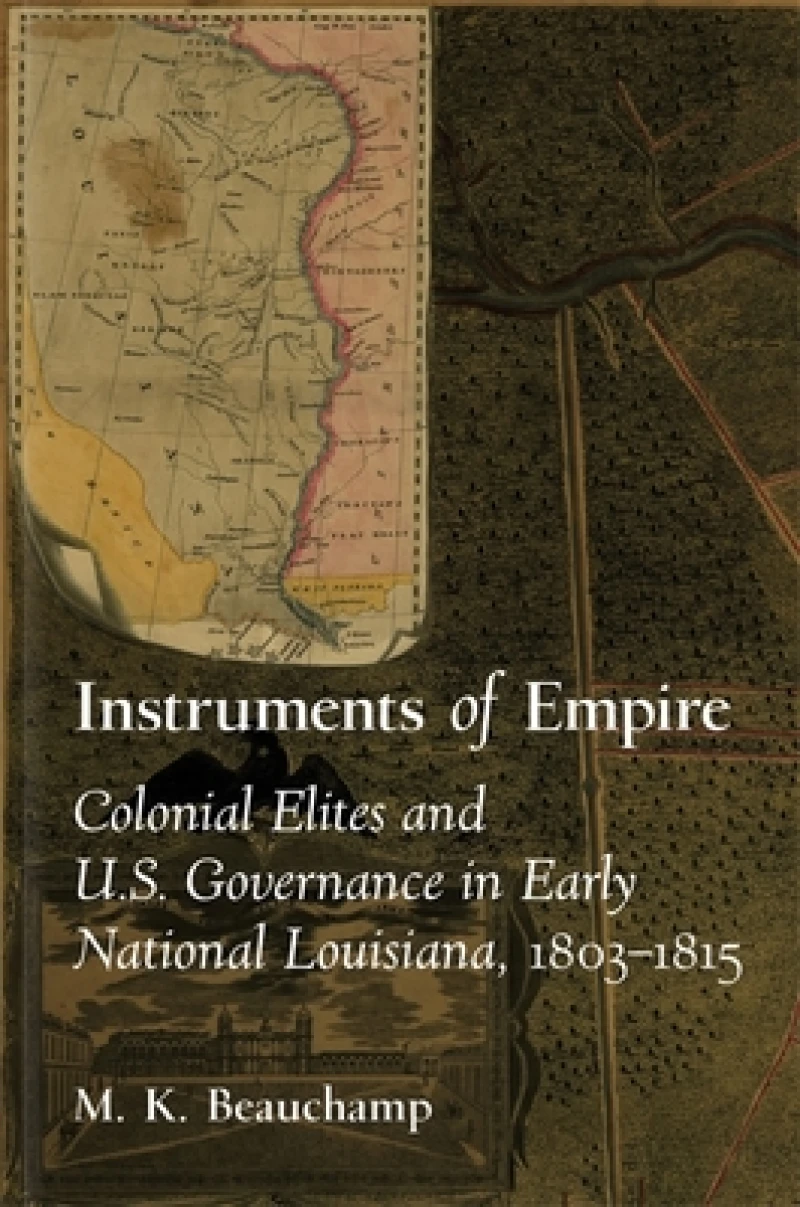
Instruments of Empire : Colonial Elites and U.S. Governance in Early National Louisiana, 1803-1815
Book Details
Format
Hardback or Cased Book
ISBN-10
0807174289
ISBN-13
9780807174289
Publisher
Louisiana State University Press
Imprint
Louisiana State University Press
Country of Manufacture
US
Country of Publication
GB
Publication Date
Feb 17th, 2021
Print length
328 Pages
Weight
600 grams
Dimensions
22.90 x 15.10 x 2.20 cms
Ksh 8,200.00
Werezi Extended Catalogue
0 in stock
Delivery Location
Delivery fee: Select location
Secure
Quality
Fast
Examines the challenges that resulted from US territorial expansion through the Louisiana Purchase of 1803. In doing so, the book offers profound insights into the interplay of class, ethnicity, and race, as well as an understanding of colonialism, the nature of republics, democracy, and empire.
M. K. Beauchamp's Instruments of Empire examines the challenges that resulted from U.S. territorial expansion through the Louisiana Purchase of 1803. With the acquisition of this vast region, the United States gained a colonial European population whose birthplace, language, and religion often differed from those of their U.S. counterparts. This population exhibited multiple ethnic tensions and possessed little experience with republican government. Consequently, administration of the territory proved a trial-and-error endeavor involving incremental cooperation between federal officials and local elites. As Beauchamp demonstrates, this process of gradual accommodation served as an essential nationalizing experience for the people of Louisiana.
After the acquisition, federal officials who doubted the loyalty of the local French population and their capacity for self-governance denied the territory of Orleans-easily the region's most populated and economically robust area-a quick path to statehood. Instead, U.S. officials looked to groups including free people of color, Native Americans, and recent immigrants, all of whom found themselves ideally placed to negotiate for greater privileges from the new territorial government. Beauchamp argues that U.S. administrators, despite claims of impartiality and equality before the law, regularly acted as fickle agents of imperial power and frequently co-opted local elites with prominent positions within the parishes. Overall, the methods utilized by the United States in governing Louisiana shared much in common with European colonial practices implemented elsewhere in North America during the early nineteenth century.
While historians have previously focused on Washington policy makers in investigating the relationship between the United States and the newly acquired territory, Beauchamp emphasizes the integral role played by territorial elites who wielded enormous power and enabled government to function. His work offers profound insights into the interplay of class, ethnicity, and race, as well as an understanding of colonialism, the nature of republics, democracy, and empire. By placing the territorial period of early national Louisiana in an imperial context, this study reshapes perceptions of American expansion and manifest destiny in the nineteenth century and beyond.
Instruments of Empire serves as a rich resource for specialists studying Louisiana and the U.S. South, as well as scholars of slavery and free people of color, nineteenth-century American history, Atlantic World and border studies, U.S. foreign relations, and the history of colonialism and empire.
After the acquisition, federal officials who doubted the loyalty of the local French population and their capacity for self-governance denied the territory of Orleans-easily the region's most populated and economically robust area-a quick path to statehood. Instead, U.S. officials looked to groups including free people of color, Native Americans, and recent immigrants, all of whom found themselves ideally placed to negotiate for greater privileges from the new territorial government. Beauchamp argues that U.S. administrators, despite claims of impartiality and equality before the law, regularly acted as fickle agents of imperial power and frequently co-opted local elites with prominent positions within the parishes. Overall, the methods utilized by the United States in governing Louisiana shared much in common with European colonial practices implemented elsewhere in North America during the early nineteenth century.
While historians have previously focused on Washington policy makers in investigating the relationship between the United States and the newly acquired territory, Beauchamp emphasizes the integral role played by territorial elites who wielded enormous power and enabled government to function. His work offers profound insights into the interplay of class, ethnicity, and race, as well as an understanding of colonialism, the nature of republics, democracy, and empire. By placing the territorial period of early national Louisiana in an imperial context, this study reshapes perceptions of American expansion and manifest destiny in the nineteenth century and beyond.
Instruments of Empire serves as a rich resource for specialists studying Louisiana and the U.S. South, as well as scholars of slavery and free people of color, nineteenth-century American history, Atlantic World and border studies, U.S. foreign relations, and the history of colonialism and empire.
Get Instruments of Empire by at the best price and quality guaranteed only at Werezi Africa's largest book ecommerce store. The book was published by Louisiana State University Press and it has pages.

