
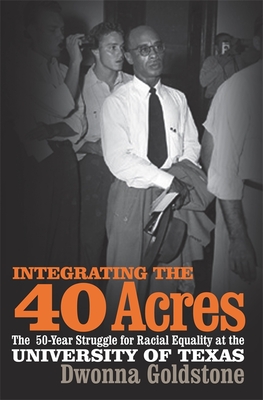
Integrating the 40 Acres : The Fifty-Year Struggle for Racial Equality at the University of Texas
Book Details
Format
Paperback / softback
ISBN-10
0820340855
ISBN-13
9780820340852
Publisher
University of Georgia Press
Imprint
University of Georgia Press
Country of Manufacture
US
Country of Publication
GB
Publication Date
Jan 15th, 2012
Print length
232 Pages
Weight
308 grams
Dimensions
23.50 x 15.60 x 1.80 cms
KSh 5,300.00
Currently unavailable
0 in stock
Delivery Location
Delivery fee: Select location
Secure
Quality
Fast
In this first full-length history of the university's desegregation, Dwonna Goldstone examines how, for decades, administrators only gradually undid the most visible signs of formal segregation while putting their greatest efforts into preventing true racial integration.
You name it, we can't do it. That was how one African American student at the University of Texas at Austin summed up his experiences in a 1960 newspaper article—some ten years after the beginning of court-mandated desegregation at the school. In this first full-length history of the university's desegregation, Dwonna Goldstone examines how, for decades, administrators only gradually undid the most visible signs of formal segregation while putting their greatest efforts into preventing true racial integration. In response to the 1956 Board of Regents decision to admit African American undergraduates, for example, the dean of students and the director of the student activities center stopped scheduling dances to prevent racial intermingling in a social setting. Goldstone's coverage ranges from the 1950 U.S. Supreme Court ruling that the University of Texas School of Law had to admit Heman Sweatt, an African American, through the 1994 Hopwood v. Texas decision, which ended affirmative action in the state's public institutions of higher education. She draws on oral histories, university documents, and newspaper accounts to detail how the university moved from open discrimination to foot-dragging acceptance to mixed successes in the integration of athletics, classrooms, dormitories, extracurricular activities, and student recruitment. Goldstone incorporates not only the perspectives of university administrators, students, alumni, and donors, but also voices from all sides of the civil rights movement at the local and national level. This instructive story of power, race, money, and politics remains relevant to the modern university and the continuing question about what it means to be integrated.
Get Integrating the 40 Acres by Dwonna Goldstone at the best price and quality guaranteed only at Werezi Africa's largest book ecommerce store. The book was published by University of Georgia Press and it has 232 pages.
Customers Who Bought This Also Bought
Crusade for Justice – The Autobiography of Ida B. Wells, Second Edition
KSh 4,050.00

Killers of the Flower Moon
KSh 2,000.00

Warmth of Other Suns
KSh 3,050.00

Frederick Douglass
KSh 3,350.00

107 Days
KSh 4,500.00

Second Treatise of Government – Norton Library
KSh 1,600.00

Tuesdays With Morrie
KSh 2,000.00
My Bondage and My Freedom
KSh 1,600.00

Hidden Figures
KSh 2,000.00

America, América
KSh 3,650.00

Holding the Line
KSh 2,000.00

Nuclear Folly
KSh 3,050.00