
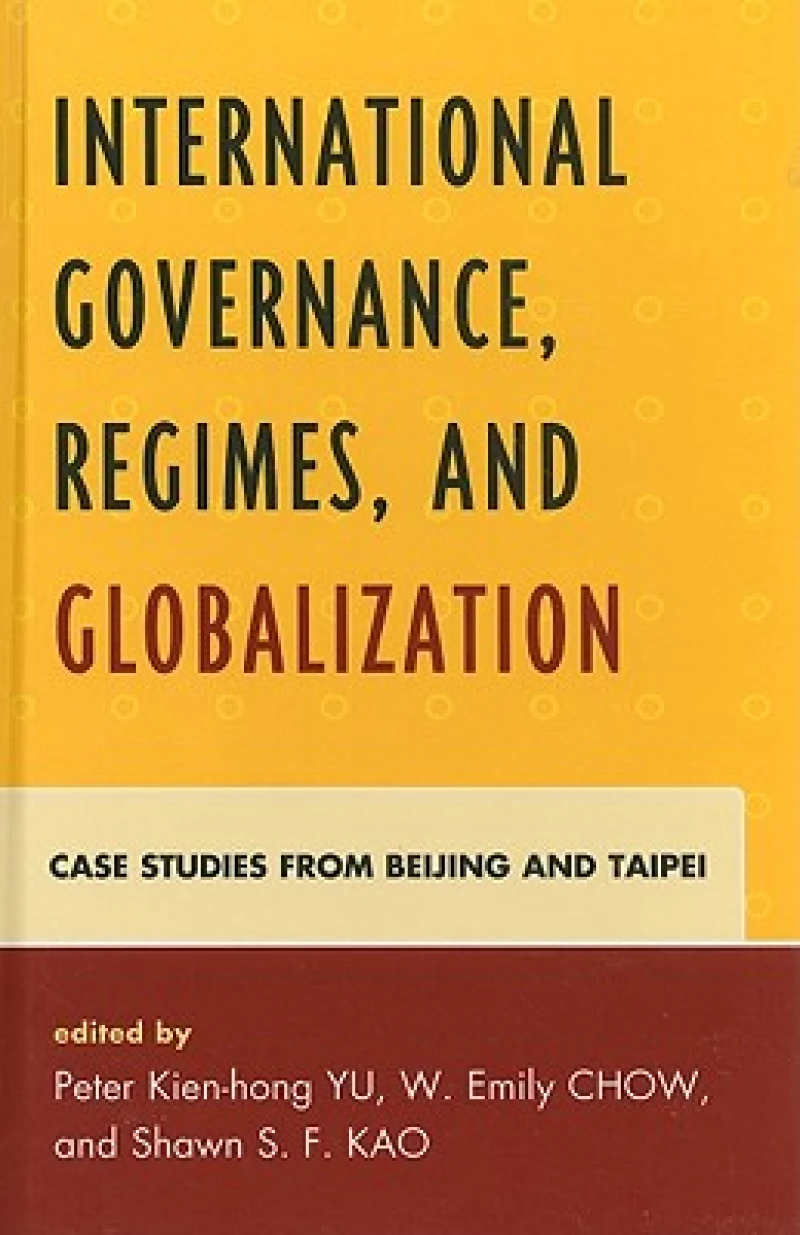
International Governance, Regimes, and Globalization : Case Studies from Beijing and Taipei
Book Details
Format
Hardback or Cased Book
ISBN-10
0739143190
ISBN-13
9780739143193
Publisher
Bloomsbury Publishing Plc
Imprint
Lexington Books
Country of Manufacture
GB
Country of Publication
GB
Publication Date
Apr 27th, 2010
Print length
224 Pages
Weight
492 grams
Dimensions
24.10 x 16.20 x 2.10 cms
Product Classification:
International relations
Ksh 19,350.00
Manufactured on Demand
0 in stock
Delivery Location
Delivery fee: Select location
Secure
Quality
Fast
In the this collection, International Governance, Regimes, and Globalization, the writers explore international relations and globalization by using specific examples from Beijing and Taipei. In December 1949, when China was politically divided the People's Republic of China (PRC) central government was in control of most resources, tangible and intangible. For that reason, our unit of analysis has to be the state, meaning a government or a politically organized body. With the rise of civil society at both national and international levels, applying the international/global governance theory should be closer to reality, because we have to look at both the state and non-state-sponsored dimensions, which are more complex and complicated. Indeed, international/global governance could become a new school of thought and will continue to expand as academics explore. For example, neo-liberalism primarily focuses on market and contract. When people buy and sell something, they are in a market. In other words, politics is the superstructure of economics or as Karl Marx said what prevails in economy will ultimately prevail in politics. In a sense, subscribers to this school of thought are Marxian. However, the study of international/global governance embraces the non-state sponsored dimension. Hence, it is broader than that of the neo-liberalism school of thought.
In the this collection, International Governance, Regimes, and Globalization, the writers explore international relations and globalization by using specific examples from Beijing and Taipei. In December 1949, when China was politically divided the People''s Republic of China (PRC) central government was in control of most resources, tangible and intangible. For that reason, our unit of analysis has to be the state, meaning a government or a politically organized body. With the rise of civil society at both national and international levels, applying the international/global governance theory should be closer to reality, because we have to look at both the state and non-state-sponsored dimensions, which are more complex and complicated. Indeed, international/global governance could become a new school of thought and will continue to expand as academics explore. For example, neo-liberalism primarily focuses on market and contract. When people buy and sell something, they are in a market. In other words, politics is the superstructure of economics or as Karl Marx said what prevails in economy will ultimately prevail in politics. In a sense, subscribers to this school of thought are Marxian. However, the study of international/global governance embraces the non-state sponsored dimension. Hence, it is broader than that of the neo-liberalism school of thought.
Get International Governance, Regimes, and Globalization by at the best price and quality guaranteed only at Werezi Africa's largest book ecommerce store. The book was published by Bloomsbury Publishing Plc and it has pages.

