
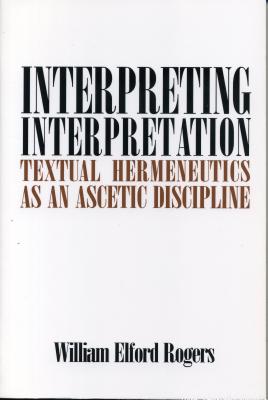
Interpreting Interpretation : Textual Hermeneutics as an Ascetic Discipline
Book Details
Format
Paperback / softback
ISBN-10
0271027339
ISBN-13
9780271027333
Publisher
Pennsylvania State University Press
Imprint
Pennsylvania State University Press
Country of Manufacture
GB
Country of Publication
GB
Publication Date
Sep 15th, 1993
Print length
256 Pages
Weight
399 grams
Dimensions
22.90 x 15.20 x 2.00 cms
Product Classification:
Translation & interpretationLiterature: history & criticismLiterary theoryPhilosophy
KSh 5,750.00
Currently unavailable
0 in stock
Delivery Location
Delivery fee: Select location
Secure
Quality
Fast
In Interpreting Interpretation, William E. Rogers searches for a model for literary education. This model should avoid both of two undesirable alternatives. First, it should not destroy any notion of discipline in the traditional sense, terminating in the stance of Rorty's "liberal ironist." Second, it should not regard literary education as an attempt to cause students to ingest a pre-determined mix of facts and cultural values, terminating in the stance of E. D. Hirsch's "cultural literate." From the semiotics of C. S. Peirce, Rogers develops the notion of interpretive system. The interpretive system called textual hermeneutics is used to interpret interpretation. From that perspective, the world looks like a text. Applying the principle rigorously allows an articulation of the problematic relations among interpretation, philosophy, and language itself. Interpreting Interpretation clarifies the conception of textual hermeneutics as an ascetic discipline by showing the consequences of this conception for interpreting canonical texts and for humanities education in general. Discussions of poetry by Robert Frost and by John Ashbery illustrate how this conception applies to an analysis of literary texts. Ultimately, the book offers a Peircean alternative to the educational theories implied in the pragmatism of John Dewey and of Richard Rorty. Rogers provides a new vocabulary for talking about what people are doing when they read, write, speak, and hear interpretive statements about texts. The new vocabulary acknowledges the great difficulty of "teaching texts" in the face of postmodern anxieties about pluralism, relativism, or nihilism. What emerges is not curriculum but method—an argument that the humanities teach not texts but interpretive systems.
Get Interpreting Interpretation by William E. Rogers at the best price and quality guaranteed only at Werezi Africa's largest book ecommerce store. The book was published by Pennsylvania State University Press and it has 256 pages.
Customers Who Bought This Also Bought

Mansi
KSh 1,800.00

Hearing the Message of Ecclesiastes
KSh 2,350.00

How to Study the Bible''s Use of the Bible
KSh 5,400.00

NKJV Study Bible, Leathersoft, Purple, Full-Color, Thumb Indexed, Comfort Print
KSh 14,750.00

Experiences in Translation
KSh 3,600.00

The Gruffalo Latin Edition
KSh 2,700.00
Thinking Through Translation
KSh 5,050.00

The Mirror of Death
KSh 5,400.00

Ethics of Generative AI in Translation
KSh 30,950.00

The Impossible Teachings of Jesus
KSh 3,600.00

Research Methods in Interpreting
KSh 18,000.00

Modern Game Localization
KSh 9,900.00
