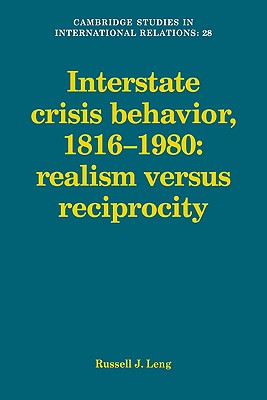
Interstate Crisis Behavior, 1816 1980
Book Details
Format
Hardback
Book Series
Cambridge Studies in International Relations
ISBN-10
0521391415
ISBN-13
9780521391412
Publisher
Cambridge University Press
Imprint
Cambridge University Press
Country of Manufacture
GB
Country of Publication
GB
Publication Date
Jun 10th, 1993
Print length
280 Pages
Weight
566 grams
Dimensions
16.00 x 23.60 x 2.50 cms
Product Classification:
International relations
KSh 19,600.00
Currently unavailable
0 in stock
Delivery Location
Delivery fee: Select location
Secure
Quality
Fast
The author concludes that elements of both realist and psychological perspectives are necessary for an adequate understanding of interstate crisis behavior and that the most effective approach to crisis bargaining combines each perspective in a firm-but-flexible 'reciprocating' strategy.
Why have some interstate crises escalated to war when other have not? Are there patterns of behavior that war-prone disputes share in common? These are some of the questions considered by Russell Leng as he examines the behavior of nations in forty militarised crises occurring between 1816 and 1980. Leng considers the conditions under which crises are more or less likely to escalate to war or be resolved peacefully and compares the descriptive and prescriptive validity of two competing perspectives on conflict behavior: classical realism and the psychological approaches of behavioral scientists. The author concludes that elements of both realist and psychological perspectives are necessary for an adequate understanding of interstate crisis behavior and that the most effective approach to crisis bargaining combines each perspective in a firm-but-flexible 'reciprocating' strategy. The epilogue presents a provocative critique of the bargaining strategies pursued by the United States and Iraq during the Gulf Crisis of 1990–1991.
Get Interstate Crisis Behavior, 1816 1980 by Russell J. Leng at the best price and quality guaranteed only at Werezi Africa's largest book ecommerce store. The book was published by Cambridge University Press and it has 280 pages.
Customers Who Bought This Also Bought

Black Wave
KSh 2,700.00

Siege
KSh 2,000.00

Extractive Capitalism
KSh 2,150.00
Strategy
KSh 4,350.00

Fourth Industrial Revolution
KSh 2,700.00

On China
KSh 3,400.00
Dead Aid
KSh 3,400.00
The Bottom Billion
KSh 2,500.00

Leadership
KSh 2,700.00
How to Win a Trade War
KSh 3,050.00

Understanding Global Conflict and Cooperation: An Introduction to Theory and History
KSh 14,000.00

Nuclear Age
KSh 5,400.00