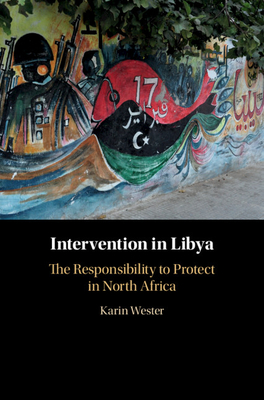
Intervention in Libya : The Responsibility to Protect in North Africa
by
Karin Wester
Book Details
Format
Paperback / softback
ISBN-10
110870185X
ISBN-13
9781108701853
Publisher
Cambridge University Press
Imprint
Cambridge University Press
Country of Manufacture
GB
Country of Publication
GB
Publication Date
Jun 16th, 2022
Print length
366 Pages
Weight
532 grams
Dimensions
15.20 x 22.70 x 2.50 cms
KSh 5,450.00
Currently unavailable
0 in stock
Delivery Location
Delivery fee: Select location
Secure
Quality
Fast
An original reconstruction of the evolution of and international diplomatic response to the 2011 Libyan crisis, which draws on a diverse range of sources including in-depth interviews with politicians and diplomats to understand the real-world application of the UN's 'Responsibility to Protect' principle.
The 2011 crisis in Libya represents the first case in which the international community invoked ''the Responsibility to Protect'' principle, adopted in 2005 by UN member states, to justify coercive measures including sanctions and the use of military force. In this study, Karin Wester meticulously reconstructs and analyzes the evolution of the Libyan crisis, the international community''s response, and the manner in which the ''Responsibility to Protect'' was applied. Drawing on a wide variety of primary sources including in-depth interviews with politicians and diplomats, this comprehensive account of the 2011 intervention in Libya redresses popular narratives asserting that the intervention was driven primarily by western (neo-colonial) interests or by a desire for regime change. Instead, Wester reveals how the ''Responsibility to Protect'' principle was realized to a considerable extent, but also how it provided a highly fragile basis for military enforcement action. Incorporating perspectives from international law, political science and history, this is a compelling and thought-provoking examination of the real-world application of a principle that is deeply rooted in history but presents daunting challenges in implementation.
Get Intervention in Libya by Karin Wester at the best price and quality guaranteed only at Werezi Africa's largest book ecommerce store. The book was published by Cambridge University Press and it has 366 pages.
Customers Who Bought This Also Bought

Regime Change
KSh 5,050.00

Art of War / The Book of Lord Shang
KSh 1,100.00

Wretched of the Earth
KSh 2,000.00

White Saviorism In International Development
KSh 3,800.00

How To Do Nothing
KSh 2,700.00

How Civil Wars Start
KSh 2,000.00

Tomorrow Is Yesterday
KSh 4,700.00

The Thinking Machine
KSh 2,350.00

Second Treatise of Government – Norton Library
KSh 1,600.00

Becoming
KSh 2,350.00

A River in Darkness
KSh 1,250.00
Warning to the West
KSh 1,600.00