
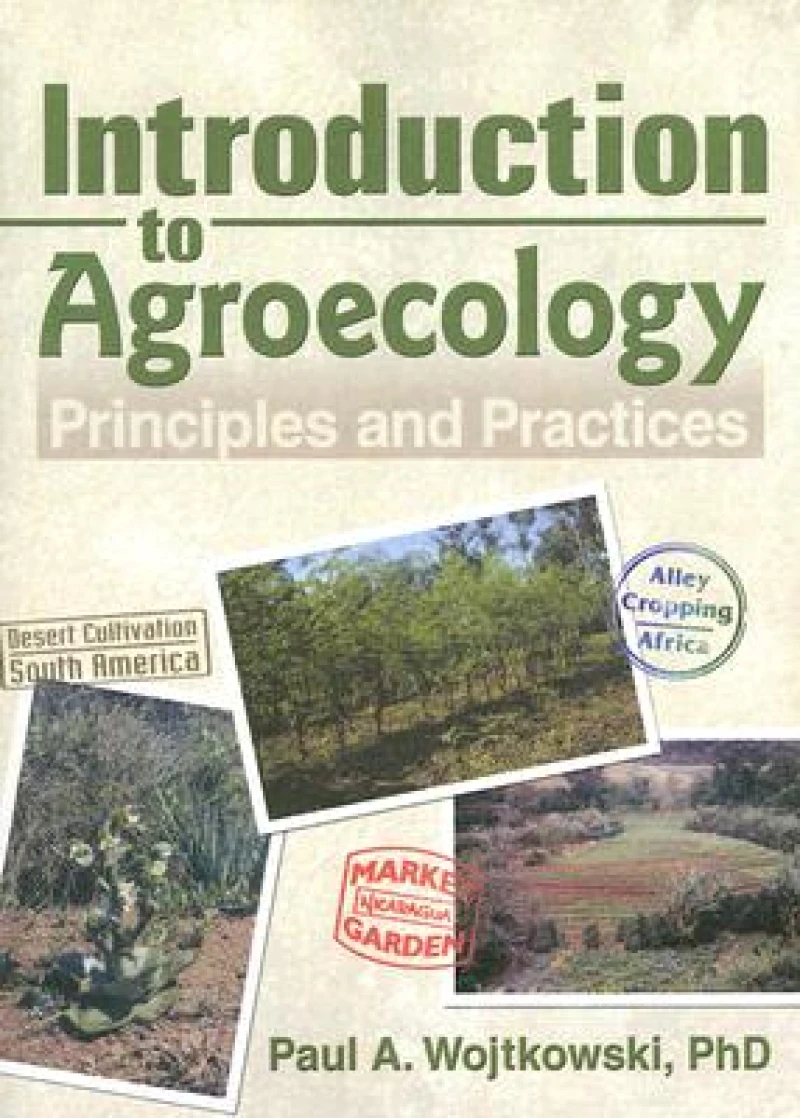
Introduction to Agroecology : Principles and Practices
Book Details
Format
Paperback / Softback
ISBN-10
1560223170
ISBN-13
9781560223177
Publisher
Taylor & Francis Inc
Imprint
CRC Press Inc
Country of Manufacture
GB
Country of Publication
GB
Publication Date
Oct 17th, 2006
Print length
424 Pages
Weight
635 grams
Product Classification:
Ecological science, the BiosphereAgriculture & farming
Ksh 26,300.00
Re-Printing
0 in stock
Delivery Location
Delivery fee: Select location
Secure
Quality
Fast
The essence of agroecology lies in harnessing and harmonizing the forces of nature for productive purpose. This book explains how this is done, providing a detailed look at the underlying theories, concepts, and practices. It is suitable for researchers, extension advisors, instructors, and students in the field.
A crucial reference/textbook that provides a wide spectrum of information in one easily understandable source
The essence of agroecology lies in harnessing and harmonizing the forces of nature for productive purpose. Introduction to Agroecology: Principles and Practices comprehensively explains how this is done, providing a detailed, inclusive look at the underlying theories, concepts, and practices. This allows the reader to explore the full range of possibilities of the nature/agricultural interface and to view agroecology in its entirety, all while providing a clear understanding of the inherent complexity. Productive threats to cropping such as soil depletion, drought, plant-eating insects, heat and cold, weeds, and small and large animals are discussed in depthwith preventative strategies for eachall together in one easy-to-use book.
This unique introductory reference source is not only aimed at the novice, but also the more advanced student. In a departure from the norm for introductory material, extensive endnotes elaborate upon the basic information, presenting a full look at the arguments and controversies within the field. The endnotes include over 500 citations, offering a broad window that encompasses ecology, sociology, conservation and environmental studies, and several other fields. The text also contains numerous charts, figures, and tables to clarify data and ideas.
Introduction to Agroecology reviews and discusses:
Introduction to Agroecology is a unique and accessible reference for those who seek a deeper understanding of the mechanisms and practices that provide a solid foundation for the study of agroecology, including researchers, extension advisors, instructors, and students.
The essence of agroecology lies in harnessing and harmonizing the forces of nature for productive purpose. Introduction to Agroecology: Principles and Practices comprehensively explains how this is done, providing a detailed, inclusive look at the underlying theories, concepts, and practices. This allows the reader to explore the full range of possibilities of the nature/agricultural interface and to view agroecology in its entirety, all while providing a clear understanding of the inherent complexity. Productive threats to cropping such as soil depletion, drought, plant-eating insects, heat and cold, weeds, and small and large animals are discussed in depthwith preventative strategies for eachall together in one easy-to-use book.
This unique introductory reference source is not only aimed at the novice, but also the more advanced student. In a departure from the norm for introductory material, extensive endnotes elaborate upon the basic information, presenting a full look at the arguments and controversies within the field. The endnotes include over 500 citations, offering a broad window that encompasses ecology, sociology, conservation and environmental studies, and several other fields. The text also contains numerous charts, figures, and tables to clarify data and ideas.
Introduction to Agroecology reviews and discusses:
- agroecological goals, such as profit, quality of life, and minimum disturbance of the natural ecosystem
- spatial principles, with resource concepts such as capture, production, balance, and biodiversity
- planting densities, ratios, and spatial patterns
- facilitation of nutrient and water capture-transfer
- ecosystem governance
- certainty-sustainability
- threats, such as drought, wind, flood, temperature, and fire
- the use of fences, repellant plants, fauna, and other means to stave off large animal threats
- basic insect countermeasures
- agrotechnologies
- subdivision, scaling, design packages, agrobiodiversity adjustments, and mimicry
- monocultures
- seasonal intercropping
- facilitative and productive agroforestry
- the use of reservoirs, corridors, wind structures, riparian buffers, firebreaks, and other means as auxiliary systems
- land modification
- social and community agroecology
- core approaches to alternative agriculture, including genetic, microbial, varietal, rotational, and others
- agroecosystem design
- many, many more topics
Get Introduction to Agroecology by at the best price and quality guaranteed only at Werezi Africa's largest book ecommerce store. The book was published by Taylor & Francis Inc and it has pages.

