
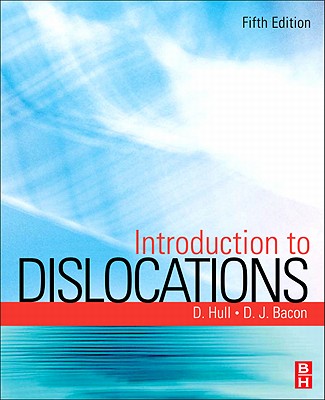
Introduction to Dislocations
Book Details
Format
Paperback / softback
ISBN-10
0080966721
ISBN-13
9780080966724
Publisher
Elsevier Science & Technology
Imprint
Butterworth-Heinemann Ltd
Country of Manufacture
US
Country of Publication
GB
Publication Date
Feb 18th, 2011
Print length
272 Pages
Weight
558 grams
Dimensions
23.20 x 18.90 x 1.60 cms
Product Classification:
Materials science
KSh 9,000.00
Werezi Extended Catalogue
Delivery in 12 days
1 copies in stock
Delivery Location
Delivery fee: Select location
Delivery in 12 days
Secure
Quality
Fast
Dislocations are defects in the crystal structure of important engineering materials, such as metals, ceramics and semi-conductors, that strongly influence the properties of these materials. This title uses minimal mathematics to present theory and applications of dislocations.
In materials science, dislocations are irregularities within the crystal structure or atomic scale of engineering materials, such as metals, semi-conductors, polymers, and composites. Discussing this specific aspect of materials science and engineering, Introduction to Dislocations is a key resource for students. The book provides students and practitioners with the fundamental principles required to understand dislocations. Comprised of 10 chapters, the text includes advanced computer modeling and very high-resolution electron microscopy to help readers better understand the structure of atoms close to the core of dislocations. It shows that atomic arrangement has a significant effect on the formation of dislocations and thereby on the properties of solids. The first two chapters of the book present an overview of dislocations. The crystal structures and the various defects and dislocations are discussed, and methods of observation and diagnosis of dislocations are covered. Chapters 3 to 5 discuss the behavior of dislocations and explain how changes in the structure and arrangement of atoms can affect the behavior of dislocations. The three chapters also discuss the mechanical properties of dislocations. The remaining chapters offer a detailed discussion of the mechanisms of dislocations and the mechanical strength of crystalline solids. The book is written for undergraduate- and graduate-level students in both materials science and mechanical engineering. Non-experts and novices working on mechanical properties, mechanisms of deformation and fracture, and properties of materials, as well as industrial and academic researchers, will find this book invaluable.
Get Introduction to Dislocations by D. J. Bacon, Derek Hull at the best price and quality guaranteed only at Werezi Africa's largest book ecommerce store. The book was published by Elsevier Science & Technology and it has 272 pages.
Customers Who Bought This Also Bought

Absorption Thermal Energy Storage
KSh 29,350.00

Solid-Shell Finite Element Modeling of Functionally Graded Structures
KSh 26,300.00

Model Validation and Uncertainty Quantification, 2026
KSh 18,900.00

Magnetoresponsive Soft Nanosystems
KSh 39,400.00

Special Topics & Experimental Techniques in Structural Dynamics, 2026
KSh 19,800.00

Cleaning
KSh 30,950.00

Dynamic Substructuring & Transfer Path Analysis, 2026
KSh 19,800.00

Dynamic Environments and Durability Testing, 2026
KSh 18,900.00

Advances in Manufacturing for Aerospace Alloys
KSh 21,600.00

Emerging Electrospun Materials
KSh 22,500.00

Topics in Modal Analysis & Parameter Identification in Structural Dynamics, 2026
KSh 19,800.00

Cleaning
KSh 7,200.00
More in This Genre
Absorption Thermal Energy Storage
KSh 29,350.00
Solid-Shell Finite Element Modeling of Functionally Graded Structures
KSh 26,300.00
Model Validation and Uncertainty Quantification, 2026
KSh 18,900.00
Magnetoresponsive Soft Nanosystems
KSh 39,400.00
Special Topics & Experimental Techniques in Structural Dynamics, 2026
KSh 19,800.00
Cleaning
KSh 30,950.00
