
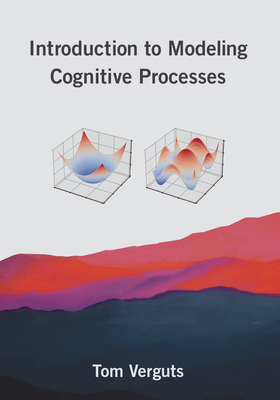
Introduction to Modeling Cognitive Processes
by
Tom Verguts
Book Details
Format
Hardback
ISBN-10
0262045362
ISBN-13
9780262045360
Publisher
MIT Press Ltd
Imprint
MIT Press
Country of Manufacture
GB
Country of Publication
GB
Publication Date
Feb 1st, 2022
Print length
256 Pages
Weight
768 grams
Dimensions
18.30 x 26.10 x 2.50 cms
Product Classification:
Cognition & cognitive psychology
KSh 8,650.00
Werezi Extended Catalogue
Delivery in 4 days
1 copies in stock
Delivery Location
Delivery fee: Select location
Delivery in 4 days
Secure
Quality
Fast
An introduction to computational modeling for cognitive neuroscientists, covering both foundational work and recent developments.
Cognitive neuroscientists need sophisticated conceptual tools to make sense of their field’s proliferation of novel theories, methods, and data. Computational modeling is such a tool, enabling researchers to turn theories into precise formulations. This book offers a mathematically gentle and theoretically unified introduction to modeling cognitive processes. Theoretical exercises of varying degrees of difficulty throughout help readers develop their modeling skills.
After a general introduction to cognitive modeling and optimization, the book covers models of decision making; supervised learning algorithms, including Hebbian learning, delta rule, and backpropagation; the statistical model analysis methods of model parameter estimation and model evaluation; the three recent cognitive modeling approaches of reinforcement learning, unsupervised learning, and Bayesian models; and models of social interaction. All mathematical concepts are introduced gradually, with no background in advanced topics required. Hints and solutions for exercises and a glossary follow the main text. All code in the book is Python, with the Spyder editor in the Anaconda environment. A GitHub repository with Python files enables readers to access the computer code used and start programming themselves. The book is suitable as an introduction to modeling cognitive processes for students across a range of disciplines and as a reference for researchers interested in a broad overview.
Cognitive neuroscientists need sophisticated conceptual tools to make sense of their field’s proliferation of novel theories, methods, and data. Computational modeling is such a tool, enabling researchers to turn theories into precise formulations. This book offers a mathematically gentle and theoretically unified introduction to modeling cognitive processes. Theoretical exercises of varying degrees of difficulty throughout help readers develop their modeling skills.
After a general introduction to cognitive modeling and optimization, the book covers models of decision making; supervised learning algorithms, including Hebbian learning, delta rule, and backpropagation; the statistical model analysis methods of model parameter estimation and model evaluation; the three recent cognitive modeling approaches of reinforcement learning, unsupervised learning, and Bayesian models; and models of social interaction. All mathematical concepts are introduced gradually, with no background in advanced topics required. Hints and solutions for exercises and a glossary follow the main text. All code in the book is Python, with the Spyder editor in the Anaconda environment. A GitHub repository with Python files enables readers to access the computer code used and start programming themselves. The book is suitable as an introduction to modeling cognitive processes for students across a range of disciplines and as a reference for researchers interested in a broad overview.
Get Introduction to Modeling Cognitive Processes by Tom Verguts at the best price and quality guaranteed only at Werezi Africa's largest book ecommerce store. The book was published by MIT Press Ltd and it has 256 pages.
Customers Who Bought This Also Bought
How Emotions Are Made
KSh 2,350.00

Gödel, Escher, Bach
KSh 4,200.00
Thinking, Fast and Slow
KSh 3,050.00

The Art of Seduction
KSh 5,050.00
Noise
KSh 2,000.00
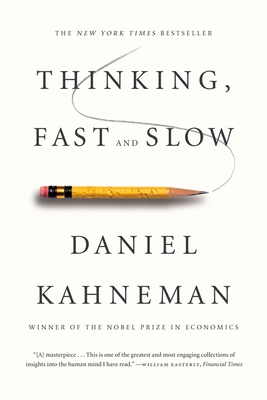
Thinking, Fast and Slow
KSh 2,700.00
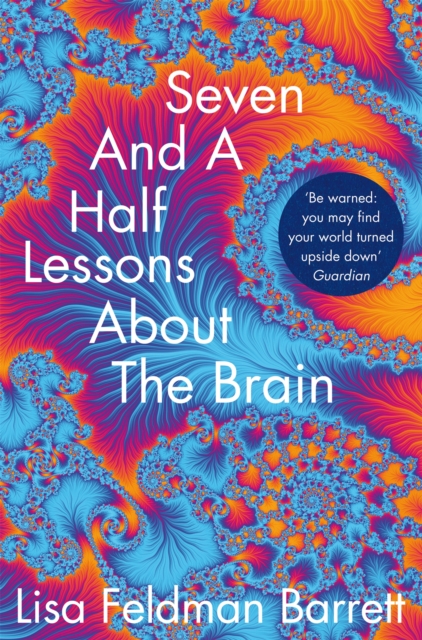
Seven and a Half Lessons About the Brain
KSh 2,000.00

Influence: Science and Practice
KSh 12,850.00

Do the Work
KSh 1,450.00

Thinking in Bets
KSh 5,050.00

Art Of Listening
KSh 3,050.00

Mind''s Eye
KSh 2,000.00
