
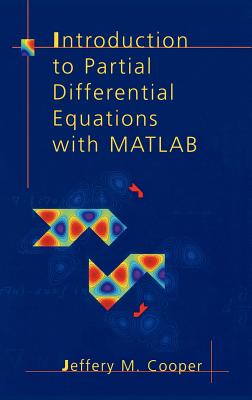
Introduction to Partial Differential Equations with MATLAB
1st ed. 1998. Corr. 2nd printing 2000
Book Details
Format
Hardback
Book Series
Applied and Numerical Harmonic Analysis
ISBN-10
0817639675
ISBN-13
9780817639679
Edition
1st ed. 1998. Corr. 2nd printing 2000
Publisher
Birkhauser Boston
Imprint
Birkhauser Boston
Country of Manufacture
US
Country of Publication
GB
Publication Date
Dec 18th, 1998
Print length
541 Pages
Weight
950 grams
Dimensions
24.20 x 16.80 x 3.70 cms
KSh 11,700.00
Currently unavailable
0 in stock
Delivery Location
Delivery fee: Select location
Secure
Quality
Fast
Overview The subject of partial differential equations has an unchanging core of material but is constantly expanding and evolving. In addition to the basic core subjects, I have included material on nonlinear problems and brief discussions of numerical methods.
Overview The subject of partial differential equations has an unchanging core of material but is constantly expanding and evolving. The core consists of solution methods, mainly separation of variables, for boundary value problems with constant coeffi cients in geometrically simple domains. Too often an introductory course focuses exclusively on these core problems and techniques and leaves the student with the impression that there is no more to the subject. Questions of existence, uniqueness, and well-posedness are ignored. In particular there is a lack of connection between the analytical side of the subject and the numerical side. Furthermore nonlinear problems are omitted because they are too hard to deal with analytically. Now, however, the availability of convenient, powerful computational software has made it possible to enlarge the scope of the introductory course. My goal in this text is to give the student a broader picture of the subject. In addition to the basic core subjects, I have included material on nonlinear problems and brief discussions of numerical methods. I feel that it is important for the student to see nonlinear problems and numerical methods at the beginning of the course, and not at the end when we run usually run out of time. Furthermore, numerical methods should be introduced for each equation as it is studied, not lumped together in a final chapter.
Get Introduction to Partial Differential Equations with MATLAB by Jeffery M. Cooper at the best price and quality guaranteed only at Werezi Africa's largest book ecommerce store. The book was published by Birkhauser Boston and it has 541 pages.
Customers Who Bought This Also Bought

Generalized Difference Methods for Differential Equations
KSh 52,200.00

Entire Functions
KSh 14,750.00

Stochastic Differential Equations
KSh 13,150.00

Nonlinear Dynamical Systems
KSh 24,550.00

Polynomial Solutions of Linear Differential Equations
KSh 22,950.00

Advanced Mathematical Models and Integration Methods
KSh 36,700.00

A First Course in the Calculus of Variations
KSh 9,200.00

A Para-Controlled Approach to the Stochastic Yang-Mills Equation in Two Dimensions
KSh 13,150.00
Differential Equations
KSh 13,500.00

A Textbook on Ordinary Differential Equations
KSh 9,550.00

Attractors for Degenerate Parabolic Type Equations
KSh 19,800.00

Isogeometric Analysis and Applications 2018
KSh 23,400.00
More in This Genre
Generalized Difference Methods for Differential Equations
KSh 52,200.00
Entire Functions
KSh 14,750.00
Stochastic Differential Equations
KSh 13,150.00
Nonlinear Dynamical Systems
KSh 24,550.00
Polynomial Solutions of Linear Differential Equations
KSh 22,950.00
Advanced Mathematical Models and Integration Methods
KSh 36,700.00
