
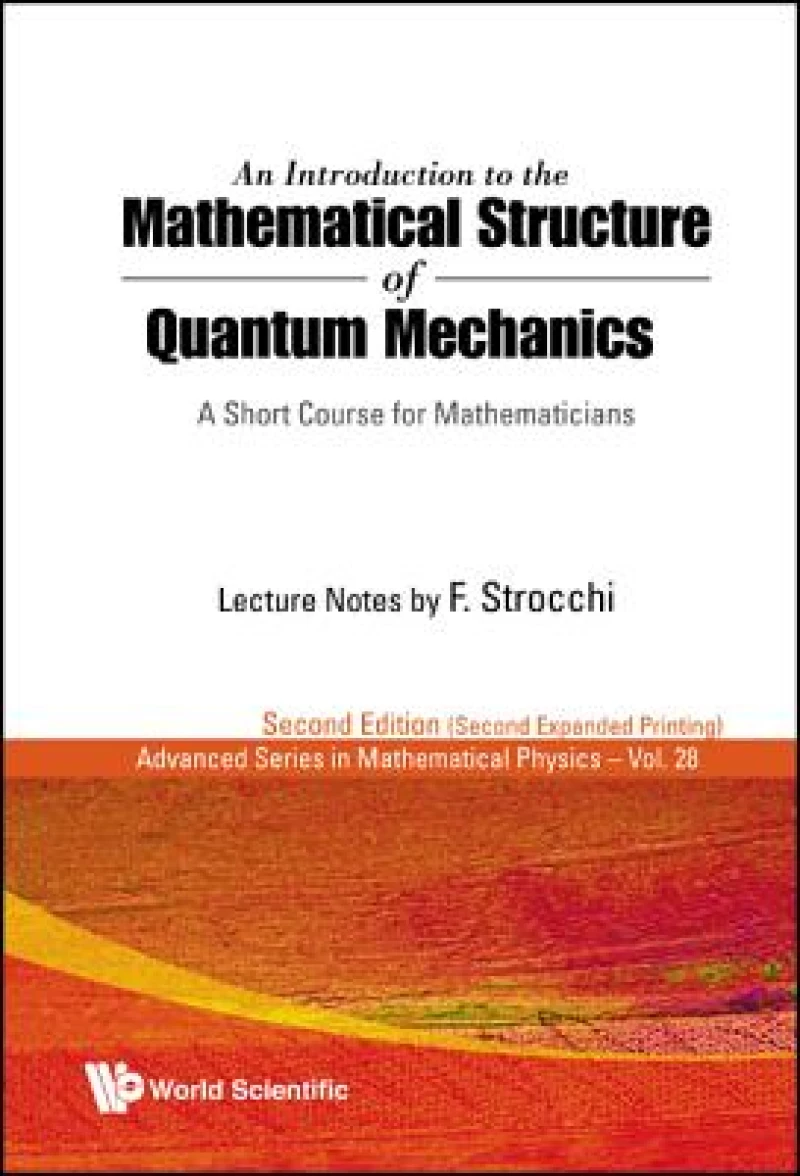
Introduction To The Mathematical Structure Of Quantum Mechanics, An: A Short Course For Mathematicians (2nd Edition)
Book Details
Format
Hardback or Cased Book
Book Series
Advanced Series In Mathematical Physics
ISBN-10
9812835229
ISBN-13
9789812835222
Publisher
World Scientific Publishing Co Pte Ltd
Imprint
World Scientific Publishing Co Pte Ltd
Country of Manufacture
GB
Country of Publication
GB
Publication Date
Nov 3rd, 2008
Print length
194 Pages
Weight
494 grams
Dimensions
23.40 x 16.10 x 1.90 cms
Ksh 11,000.00
Temporarily out of stock, due soon
0 in stock
Delivery Location
Delivery fee: Select location
Secure
Quality
Fast
Arising out of the need for Quantum Mechanics (QM) to be part of the common education of mathematics students, this book formulates the mathematical structure of QM in terms of the C*-algebra of observables, which is argued on the basis of the operational definition of measurements and the duality between states and observables.
The second printing contains a critical discussion of Dirac derivation of canonical quantization, which is instead deduced from general geometric structures. This book arises out of the need for Quantum Mechanics (QM) to be part of the common education of mathematics students. The mathematical structure of QM is formulated in terms of the C*-algebra of observables, which is argued on the basis of the operational definition of measurements and the duality between states and observables, for a general physical system.The Dirac-von Neumann axioms are then derived. The description of states and observables as Hilbert space vectors and operators follows from the GNS and Gelfand-Naimark Theorems. The experimental existence of complementary observables for atomic systems is shown to imply the noncommutativity of the observable algebra, the distinctive feature of QM; for finite degrees of freedom, the Weyl algebra codifies the experimental complementarity of position and momentum (Heisenberg commutation relations) and Schrödinger QM follows from the von Neumann uniqueness theorem.The existence problem of the dynamics is related to the self-adjointness of the Hamiltonian and solved by the Kato-Rellich conditions on the potential, which also guarantee quantum stability for classically unbounded-below Hamiltonians. Examples are discussed which include the explanation of the discreteness of the atomic spectra.Because of the increasing interest in the relation between QM and stochastic processes, a final chapter is devoted to the functional integral approach (Feynman-Kac formula), to the formulation in terms of ground state correlations (the quantum mechanical analog of the Wightman functions) and their analytic continuation to imaginary time (Euclidean QM). The quantum particle on a circle is discussed in detail, as an example of the interplay between topology and functional integral, leading to the emergence of superselection rules and ? sectors.
Get Introduction To The Mathematical Structure Of Quantum Mechanics, An: A Short Course For Mathematicians (2nd Edition) by at the best price and quality guaranteed only at Werezi Africa's largest book ecommerce store. The book was published by World Scientific Publishing Co Pte Ltd and it has pages.

