
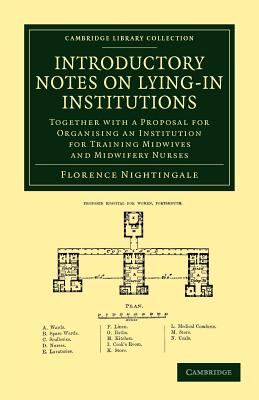
Introductory Notes on Lying-In Institutions : Together with a Proposal for Organising an Institution for Training Midwives and Midwifery Nurses
Book Details
Format
Paperback / softback
ISBN-10
110805319X
ISBN-13
9781108053198
Publisher
Cambridge University Press
Imprint
Cambridge University Press
Country of Manufacture
GB
Country of Publication
GB
Publication Date
Jun 28th, 2012
Print length
140 Pages
Weight
190 grams
Dimensions
21.60 x 14.00 x 0.80 cms
Product Classification:
History of medicineMidwifery
KSh 4,150.00
Currently unavailable
0 in stock
Delivery Location
Delivery fee: Select location
Secure
Quality
Fast
By the late nineteenth century, it was still safer for a woman to give birth at home than in a maternity hospital. In this book, first published in 1871, Florence Nightingale (1820–1910) provides a detailed statistical analysis of the problem, including her conclusions and recommendations for improvement.
The greatest postnatal killer of the nineteenth century was puerperal fever. A vicious and usually fatal form of septicaemia, puerperal or childbed fever was known to occur in maternity hospitals far more frequently than at home births, and to spread faster in crowded wards than in those with fewer patients. Its cause was unknown. In this precise statistical analysis of the facts, gathered from several sources across the major cities of Europe, Florence Nightingale (1820–1910) explores the mystery of puerperal fever and its possible causes. She stresses the necessity of good ventilation in hospitals, condemning those with overcrowded wards, and cites instances where the layout of wards has a noticeable correlation with the number of deaths. Published in 1871, just before Pasteur's work on germ theory proved that the problem could be all but eradicated if doctors washed their hands more rigorously, this work remains clear, scholarly and engaging.
Get Introductory Notes on Lying-In Institutions by Florence Nightingale at the best price and quality guaranteed only at Werezi Africa's largest book ecommerce store. The book was published by Cambridge University Press and it has 140 pages.
Customers Who Bought This Also Bought

Replaceable You
KSh 3,400.00

Unwell Women
KSh 2,350.00

Cultural History of Disability in the Modern Age
KSh 4,850.00

The Elements and Practice of Rigging and Seamanship. Illustrated With Engravings. In two Volumes. ... of 2; Volume 1
KSh 4,700.00

Armies of Pestilence
KSh 5,400.00

The Disabled Gaze
KSh 4,500.00
Empty Sleeves
KSh 5,500.00

The History of the Medical College of Georgia
KSh 10,000.00

The First Anesthetic – The Story of Crawford Long
KSh 5,000.00

Borders and Sanitation from the Seventeenth to the Twenty-First Century
KSh 30,950.00

Cabanis – Enlightenment and Medical Philosophy in the French Revolution
KSh 30,050.00

The History of the Medical College of Georgia
KSh 6,100.00
More by Florence Nightingale

Workhouse Nursing
KSh 4,250.00

Des Soins a Donner aux Malades: Ce qu'Il Faut Faire, ce qu'Il Faut Eviter (Classic Reprint)
KSh 4,650.00

Notes on Nursing
KSh 5,250.00

Notes on Hospitals (Classic Reprint)
KSh 3,150.00

Notes on Nursing
KSh 1,800.00

Notes On Nursing
KSh 3,050.00
Notes on Nursing
KSh 1,350.00

Notes on Hospitals
KSh 1,800.00

Notes on Nursing
KSh 2,200.00

Cassandra and Suggestions for Thought by Florence Nightingale
KSh 12,850.00
Notes on Hospitals
KSh 4,150.00
Cassandra
KSh 1,450.00
More in This Genre
Replaceable You
KSh 3,400.00
Unwell Women
KSh 2,350.00
Cultural History of Disability in the Modern Age
KSh 4,850.00
The Elements and Practice of Rigging and Seamanship. Illustrated With Engravings. In two Volumes. ... of 2; Volume 1
KSh 4,700.00
Armies of Pestilence
KSh 5,400.00
The Disabled Gaze
KSh 4,500.00
