
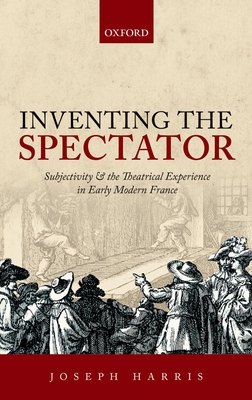
Inventing the Spectator : Subjectivity and the Theatrical Experience in Early Modern France
Book Details
Format
Hardback
ISBN-10
0198701616
ISBN-13
9780198701613
Publisher
Oxford University Press
Imprint
Oxford University Press
Country of Manufacture
GB
Country of Publication
GB
Publication Date
May 1st, 2014
Print length
294 Pages
Weight
498 grams
Dimensions
22.20 x 14.70 x 2.20 cms
KSh 23,450.00
Temporarily out of stock, due soon
0 in stock
Delivery Location
Delivery fee: Select location
Secure
Quality
Fast
Inventing the Spectator reconstructs the theatre spectator's experience as it was understood in France between the Renaissance and the Revolution, raising numerous questions that strike at the very heart of human psychology, cognition, and experience.
During the seventeenth and eighteenth centuries, France became famous -- notorious even -- across Europe for its ambitious attempts to codify and theorise a system of universally valid dramatic ''rules''. So fundamental and formative was this ''classical'' conception of drama that it still underpins our modern conception of theatre today. Yet rather than rehearsing familiar arguments about plays, Inventing the Spectator reads early modern France''s dramatic theory against the grain, tracing instead the profile and characteristics of the spectator that these arguments imply: the living, breathing individual in whose mind, senses, and experience the theatre comes to life. In so doing, Joseph Harris raises numerous questions -- of imagination and illusion, reason and emotion, vision and aurality, to name but a few -- that strike at the very heart of human psychology, cognition, and experience. Bridging the gap between literary and theatre studies, history of psychology, and intellectual history, Inventing the Spectator thus reconstructs the theatre spectator''s experience as it was understood and theorised within French dramatic theory between the Renaissance and the Revolution. It explores early modern spectatorship through three main themes (illusion and the senses; pleasure and narrative; interest and identification) and five key dramatic theoreticians (d''Aubignac, Corneille, Dubos, Rousseau, and Diderot). As it demonstrates, the period''s dramatic rules are at heart rules of psychology, cognition, and affect that emerged out of a complex dialogue with human subjectivity in all its richness.
Get Inventing the Spectator by Joseph Harris at the best price and quality guaranteed only at Werezi Africa's largest book ecommerce store. The book was published by Oxford University Press and it has 294 pages.
Customers Who Bought This Also Bought

Arabian Nights'' Entertainments
KSh 2,950.00
Robinson Crusoe
KSh 1,450.00
Metaphysical Poetry
KSh 2,350.00
A Portrait of the Artist as a Young Man
KSh 1,250.00

Shakespeare Book
KSh 4,250.00

Don Quixote de la Mancha
KSh 2,150.00
Lorna Doone
KSh 2,000.00

Tom Jones
KSh 5,400.00
Tom Jones
KSh 2,250.00

Micromégas and Other Short Fictions
KSh 2,350.00
Murder Among Friends
KSh 22,750.00

Hamlet: Poem Unlimited
KSh 1,800.00
More by Joseph Harris

Achieving Access
KSh 5,750.00

Misanthropy in the Age of Reason
KSh 19,100.00
An Essay upon Money and Coins
KSh 4,700.00

Ghost Projekt
KSh 3,250.00
A Teaching Subject
KSh 4,850.00
The Work of Teaching Writing
KSh 3,850.00

Principles of Algebraic Geometry
KSh 26,250.00
The Description and Use of the Globes, and the Orrery
KSh 4,500.00

Harris on the Pig
KSh 2,800.00
Exposure
KSh 9,250.00
Rewriting
KSh 3,700.00
