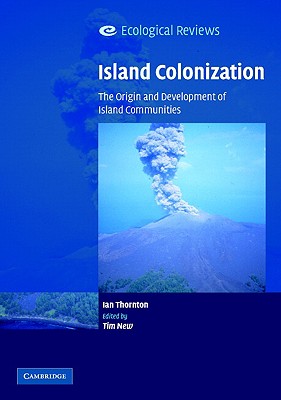
Island Colonization : The Origin and Development of Island Communities
by
Ian Thornton
Book Details
Format
Paperback / softback
Book Series
Ecological Reviews
ISBN-10
052167106X
ISBN-13
9780521671064
Publisher
Cambridge University Press
Imprint
Cambridge University Press
Country of Manufacture
GB
Country of Publication
GB
Publication Date
Mar 19th, 2007
Print length
302 Pages
Weight
522 grams
Dimensions
17.70 x 24.70 x 1.40 cms
KSh 9,200.00
Currently unavailable
0 in stock
Delivery Location
Delivery fee: Select location
Secure
Quality
Fast
A broad review of island colonization, specifically how animal and plant communities establish, bringing together succession models and general principles with case studies. This book is a personal and readable account of a suite of complex themes of very wide interest and relevance to ecologists and conservation biologists throughout the world.
New or recently sterilized islands (for example through volcanic activity), provide ecologists with natural experiments in which to study colonization, development and establishment of new biological communities. Studies carried out on islands like this have provided answers to fundamental questions as to what general principles are involved in the ecology of communities and what processes underlie and maintain the basic structure of ecosystems. These studies are vital for conservation biology, especially when evolutionary processes need to be maintained in systems in order to maintain biodiversity. The major themes are how animal and plant communities establish, particularly on ''new land'' or following extirpations by volcanic activity. This book comprises a broad review of island colonization, bringing together succession models and general principles, case studies with which Professor Ian Thornton was intimately involved, and a synthesis of ideas, concluding with a look to the future for similar studies.
Get Island Colonization by Ian Thornton at the best price and quality guaranteed only at Werezi Africa's largest book ecommerce store. The book was published by Cambridge University Press and it has 302 pages.
Customers Who Bought This Also Bought

Is a River Alive?
KSh 2,150.00

Heretics Of Dune
KSh 2,000.00

Blue Machine
KSh 2,150.00

Genius of Trees
KSh 4,500.00
Genius of Trees
KSh 3,050.00
Genius of Trees
KSh 2,350.00

For Everyone Bible Study Guide: James
KSh 1,250.00
Deep History of Ourselves
KSh 3,250.00

Deep History of Ourselves
KSh 5,400.00

Is a River Alive?
KSh 4,500.00
Kinship: Vol. 5 Practice
KSh 3,250.00
Aristotle's Classification of Animals
KSh 14,400.00