
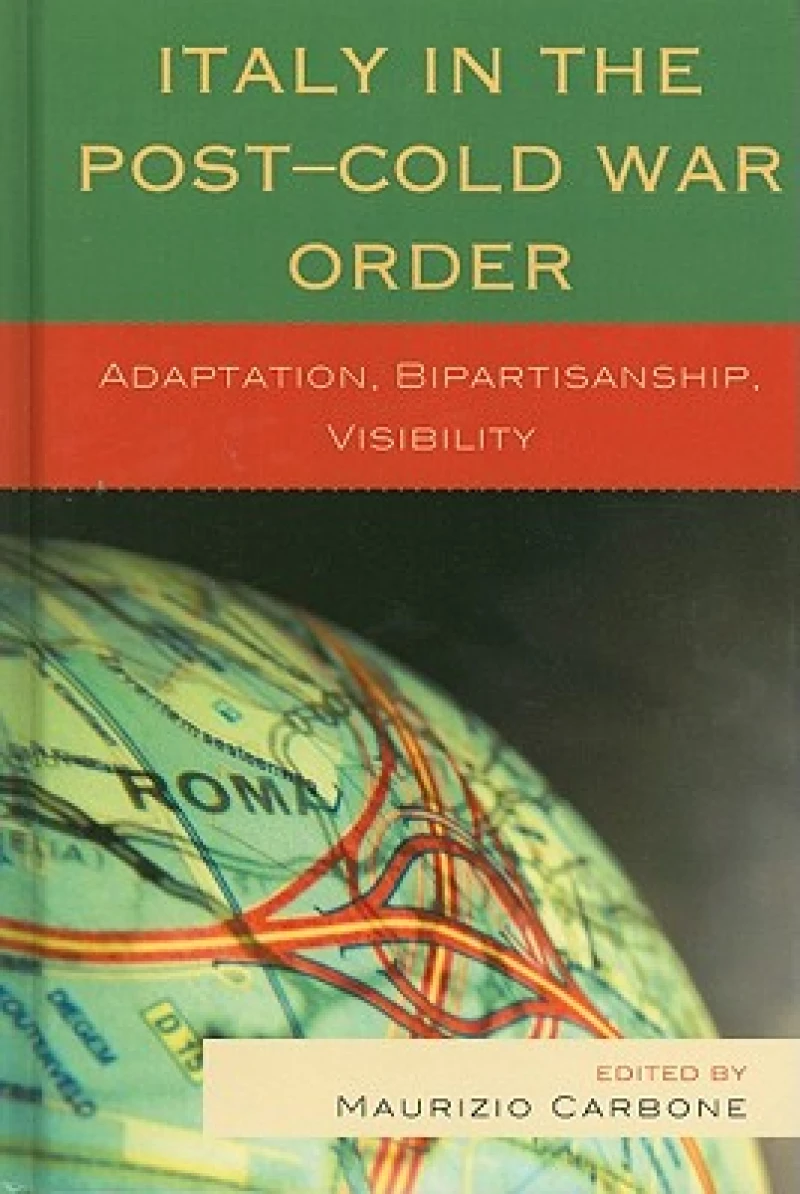
Italy in the Post-Cold War Order : Adaptation, Bipartisanship, Visibility
Book Details
Format
Hardback or Cased Book
ISBN-10
0739137115
ISBN-13
9780739137116
Publisher
Bloomsbury Publishing Plc
Imprint
Lexington Books
Country of Manufacture
GB
Country of Publication
GB
Publication Date
Feb 24th, 2011
Print length
294 Pages
Weight
592 grams
Dimensions
23.40 x 15.90 x 2.50 cms
Product Classification:
European historyPostwar 20th century history, from c 1945 to c 2000International relations
Ksh 21,350.00
Manufactured on Demand
0 in stock
Delivery Location
Delivery fee: Select location
Secure
Quality
Fast
There are little doubts that Italy has attempted to play a more assertive role in the international arena since the end of the Cold War. During the first forty years of its Republican history, conditioned by both the polarized international context and an antagonistic domestic political system, Italy delegated its main choices in international affairs to external actors, most notably NATO and the European Union. The transition from a bipolar to a unipolar/multipolar world order provided Italy with new opportunities to pursue its political and commercial interests more autonomously, as well as new responsibilities, to actively contribute to solving conflicts and addressing new global threats. At the same time, the collapse of the traditional parties (linked to the fall of the Berlin wall and the Clean Hands enquiries) and the changes of the electoral law (from a proportional representation into a quasi-majoritarian system) generated two heterogeneous coalitions which have regularly alternated in power, but do not always share the same views and approaches-with differences at times of form, and more often of substance. Against this background, Italy in the Post-Cold War Order: Adaptation, Bipartisanship, Visibility, edited by Maurizio Carbone, seeks to explain the evolution of Italy's international action over a twenty-year span (1989–2009). Three central questions are addressed. First, how does Italy adapt to transformations of the international system? Second, how does its ever-changing political system influence Italy's choices in foreign relations? Third, how do domestic structures constrain (or enable) Italy's place on the world stage? To answer these questions, this book consists of two broad parts. The first part sets the context and discusses issues 'horizontally,' focusing on foreign policy, security and defense policy, development cooperation, and multilateral action. The second part, which takes a 'vertical' approach, discusses Italy's relations with key countries and regions of the world
There are little doubts that Italy has attempted to play a more assertive role in the international arena since the end of the Cold War. During the first forty years of its Republican history, conditioned by both the polarized international context and an antagonistic domestic political system, Italy delegated its main choices in international affairs to external actors, most notably NATO and the European Union. The transition from a bipolar to a unipolar/multipolar world order provided Italy with new opportunities to pursue its political and commercial interests more autonomously, as well as new responsibilities, to actively contribute to solving conflicts and addressing new global threats. At the same time, the collapse of the traditional parties (linked to the fall of the Berlin wall and the Clean Hands enquiries) and the changes of the electoral law (from a proportional representation into a quasi-majoritarian system) generated two heterogeneous coalitions which have regularly alternated in power, but do not always share the same views and approaches-with differences at times of form, and more often of substance. Against this background, Italy in the Post-Cold War Order: Adaptation, Bipartisanship, Visibility, edited by Maurizio Carbone, seeks to explain the evolution of Italy''s international action over a twenty-year span (1989–2009). Three central questions are addressed. First, how does Italy adapt to transformations of the international system? Second, how does its ever-changing political system influence Italy''s choices in foreign relations? Third, how do domestic structures constrain (or enable) Italy''s place on the world stage? To answer these questions, this book consists of two broad parts. The first part sets the context and discusses issues ''horizontally,'' focusing on foreign policy, security and defense policy, development cooperation, and multilateral action. The second part, which takes a ''vertical'' approach, discusses Italy''s relations with key countries and regions of the world
Get Italy in the Post-Cold War Order by at the best price and quality guaranteed only at Werezi Africa's largest book ecommerce store. The book was published by Bloomsbury Publishing Plc and it has pages.

