
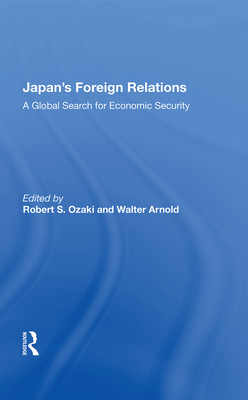
Japan''s Foreign Relations : A Global Search for Economic Security
Book Details
Format
Hardback
ISBN-10
0367016494
ISBN-13
9780367016494
Publisher
Taylor & Francis Ltd
Imprint
Routledge
Country of Manufacture
GB
Country of Publication
GB
Publication Date
Jun 7th, 2019
Print length
254 Pages
Weight
630 grams
Product Classification:
Politics & governmentPolitics and government
KSh 30,950.00
Currently unavailable
0 in stock
Delivery Location
Delivery fee: Select location
Secure
Quality
Fast
After World War II, Japan reemerged in the arena of international relations as an almost exclusively economic power without military might or territorial ambitions. Within some thirty years it transformed itself from a semideveloped state to a technological superpower with an economy that today is the second largest in the free world, next only to the United States, accounting for over 10 percent of total global production. The management of a rapidly growing industrial state with little domestic supply of resources necessarily requires great skill in the difficult task of maintaining sufficient access to overseas markets to sustain internal economic activity. Not surprisingly, then, Japan’s foreign relations from World War II to the present have been heavily conditioned by economic considerations. This collection of original articles investigates how the economic growth of Japan has affected the pattern of its foreign relations and where and to what extent economic principles have had to be compromised for political, legal, cultural, or ideological reasons. The contributors, experts on Japan’s economy, politics, and foreign relations, analyze the state of Japan’s foreign relations with North America, the EC, Oceania, the Soviet Union, COMECON, China, ASEAN, the Middle East, Latin America, Africa, Korea, and Taiwan, focusing on developments in the last seven years and predicting likely trends in the 1980s.
Get Japan''s Foreign Relations by Robert S. Ozaki at the best price and quality guaranteed only at Werezi Africa's largest book ecommerce store. The book was published by Taylor & Francis Ltd and it has 254 pages.
Customers Who Bought This Also Bought
Regime Change
KSh 5,050.00

Art of War / The Book of Lord Shang
KSh 1,100.00

Wretched of the Earth
KSh 2,000.00

White Saviorism In International Development
KSh 3,800.00
How To Do Nothing
KSh 2,700.00

How Civil Wars Start
KSh 2,000.00

Tomorrow Is Yesterday
KSh 4,700.00

The Thinking Machine
KSh 2,350.00

Second Treatise of Government – Norton Library
KSh 1,600.00

Becoming
KSh 2,350.00

A River in Darkness
KSh 1,250.00

Warning to the West
KSh 1,600.00
