
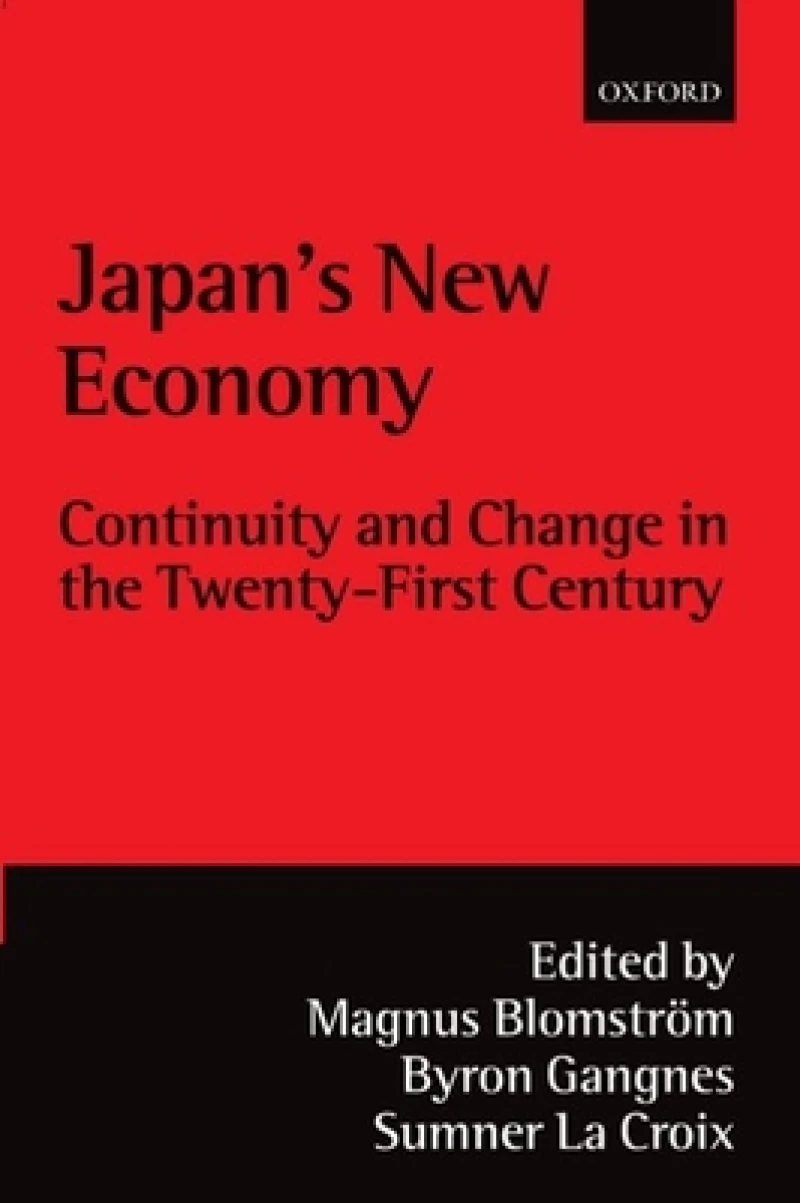
Japan's New Economy : Continuity and Change in the Twenty-First Century
Book Details
Format
Paperback / Softback
ISBN-10
0199241732
ISBN-13
9780199241736
Publisher
Oxford University Press
Imprint
Oxford University Press
Country of Manufacture
GB
Country of Publication
GB
Publication Date
Jan 25th, 2001
Print length
338 Pages
Weight
500 grams
Dimensions
23.50 x 15.60 x 1.90 cms
Product Classification:
Monetary economicsInternational economicsEconomic systems & structures
Ksh 10,350.00
Manufactured on Demand
0 in stock
Delivery Location
Delivery fee: Select location
Secure
Quality
Fast
While much has been written about Japan's pre-1990s institutions and economic performance, this text tries to understand not only the institutional and structural changes that have already reshaped Japan in the 1990s, but to identify the critical trends and institutional changes that will mould Japan's new economy over the next decade.
Japan''s economy stumbled in the 1990s. After four decades of rapid growth that transformed Japan into a wealthy country at the world''s technological frontier, the last decade brought prolonged economic stagnation. The rapid run-up in asset prices in the late 1980s, followed by their collapse in the early 1990s, left a debt overhang that paralyzed the banking sector. Policy reforms were initially half-hearted, and businesses were slow to restructure as the global economy changed. The lagging economy has seemed impervious to aggressive fiscal stimulus measures and is still plagued by ongoing price deflation. Japan''s struggle has called into question the ability of the country''s economic institutions - originally designed to support factor accumulation and rapid development - to adapt to the new economic environment of the 21st century.Yet Japan''s economy is already changing. Driven by an aging population, rapid technological change, and increasing global competition, the country''s public and private institutions are being slowly reshaped. This volume explores the forces that will drive structural and institutional change in three areas over the next decade: the macroeconomy, the organization of industry, and the global economic and political environment. Economists, demographers, and Japan specialists examine key aspects of the economy that will be transformed in coming years, including population and savings, the public pension system, labor markets, financial reforms, deregulation of service industries, productivity performance, foreign investment, trade, and the impact of an emerging China. The volume fills an important gap in the existing economic literature. While much has been written about Japan''s pre-1990s institutions and economic performance, this volume is unique in its forward-looking orientation - trying to understand not only the institutional and structural changes that have already reshaped Japan in the 1990s, but to identify the critical trends and institutional changes that will mould Japan''s new economy over the next decade.
Get Japan's New Economy by at the best price and quality guaranteed only at Werezi Africa's largest book ecommerce store. The book was published by Oxford University Press and it has pages.

