
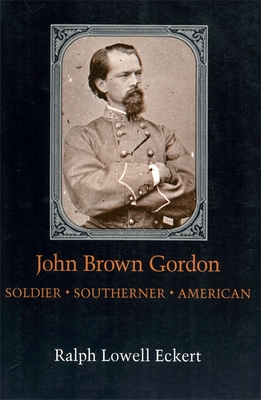
John Brown Gordon : Soldier, Southerner, American
Book Details
Format
Paperback / softback
Book Series
Southern Biography Series
ISBN-10
0807118885
ISBN-13
9780807118887
Publisher
Louisiana State University Press
Imprint
Louisiana State University Press
Country of Manufacture
US
Country of Publication
GB
Publication Date
Sep 1st, 1993
Print length
367 Pages
Weight
333 grams
Dimensions
22.80 x 15.20 x 2.10 cms
KSh 6,300.00
Currently unavailable
0 in stock
Delivery Location
Delivery fee: Select location
Secure
Quality
Fast
John Brown Gordon's career of prominent public service spanned four of America's most turbulent decades. Utilizing newspapers, scattered manuscript collections, and official records, Ralph Eckert presents a critical biography of Gordon that analyses all areas of his career.
John Brown Gordon's career of prominent public service spanned four of America's most turbulent decades. Born in Upson County, Georgia, in 1832, Gordon practiced law in Atlanta and, in the years immediately preceding the Civil War, developed coal mines in northwest Georgia. In 1861, he responded to the Confederate call to arms by raising a company of volunteers. His subsequent rise from captain to corps commander was unmatched in the Army of Northern Virginia. He emerged from the Civil War as one of the South's most respected generals, and the reputation that Gordon earned while ""wearing the gray"" significantly influenced almost every aspect of his life during the next forty years.
After the Civil War, Gordon drifted into politics. He was elected to the United States Senate in 2873 and quickly established himself as a spokesman for Georgia and for the South as a whole. He eloquently defended the integrity of southern whites while fighting to restore home rule. In addition to safeguarding and promoting southern interests, Gordon strove to replace sectional antagonisms with a commitment to building a stronger, more unified nation. His efforts throughout his post-war career contributed significantly to the process of national reconciliation.
Even in the wake of charges of corruption that surrounded his resignation from the Senate in 1880, Gordon remained an extremely popular man in the South. He engaged in a variety of speculative business ventures, served as governor of Georgia, and returned for another term in the Senate before he retired permanently from public office. He devoted his final years to lecture tours, to serving as commander-in-chief of the United Confederate Veterans, and to writing his memoirs, Reminiscences of the Civil War.
Utilizing newspapers, scattered manuscript collections, and official records, Ralph Eckert presents a critical biography of Gordon that analyses all areas of his career. As one of the few Confederates to command a corps without the benefit of previous military training, Gordon provides a fascinating example of a Civil War citizen-soldier. Equally interesting, however, were Gordon's postwar activities and the often conflicting responsibilities that he felt as a southerner and an American. The contributions that Gordon made to Georgia, to the South, and to the United States during this period are arguably as important as any of his career.
After the Civil War, Gordon drifted into politics. He was elected to the United States Senate in 2873 and quickly established himself as a spokesman for Georgia and for the South as a whole. He eloquently defended the integrity of southern whites while fighting to restore home rule. In addition to safeguarding and promoting southern interests, Gordon strove to replace sectional antagonisms with a commitment to building a stronger, more unified nation. His efforts throughout his post-war career contributed significantly to the process of national reconciliation.
Even in the wake of charges of corruption that surrounded his resignation from the Senate in 1880, Gordon remained an extremely popular man in the South. He engaged in a variety of speculative business ventures, served as governor of Georgia, and returned for another term in the Senate before he retired permanently from public office. He devoted his final years to lecture tours, to serving as commander-in-chief of the United Confederate Veterans, and to writing his memoirs, Reminiscences of the Civil War.
Utilizing newspapers, scattered manuscript collections, and official records, Ralph Eckert presents a critical biography of Gordon that analyses all areas of his career. As one of the few Confederates to command a corps without the benefit of previous military training, Gordon provides a fascinating example of a Civil War citizen-soldier. Equally interesting, however, were Gordon's postwar activities and the often conflicting responsibilities that he felt as a southerner and an American. The contributions that Gordon made to Georgia, to the South, and to the United States during this period are arguably as important as any of his career.
Get John Brown Gordon by Ralph Lowell Eckert at the best price and quality guaranteed only at Werezi Africa's largest book ecommerce store. The book was published by Louisiana State University Press and it has 367 pages.
Customers Who Bought This Also Bought

The Second Emancipation – Nkrumah, Pan–Africanism, and Global Blackness at High Tide
KSh 5,650.00

Churchill
KSh 3,700.00

Spy and the Traitor
KSh 2,150.00

King
KSh 2,700.00

American Prometheus
KSh 2,700.00

Gandhi 1914-1948
KSh 3,950.00

Warmth of Other Suns
KSh 3,050.00

Frederick Douglass
KSh 3,350.00
Lumumba
KSh 2,350.00

Kierkegaard
KSh 1,800.00

Only Plane in the Sky
KSh 2,700.00

History
KSh 9,000.00
