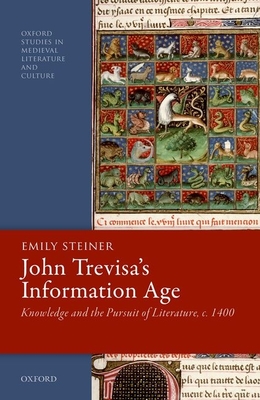
John Trevisa''s Information Age : Knowledge and the Pursuit of Literature, c. 1400
Book Details
Format
Hardback
ISBN-10
0192896903
ISBN-13
9780192896902
Publisher
Oxford University Press
Imprint
Oxford University Press
Country of Manufacture
GB
Country of Publication
GB
Publication Date
Aug 20th, 2021
Print length
300 Pages
Weight
592 grams
Dimensions
24.00 x 16.40 x 2.40 cms
KSh 18,000.00
Currently unavailable
0 in stock
Delivery Location
Delivery fee: Select location
Secure
Quality
Fast
Explores reference books in the medieval period including informational texts, encyclopedias, histories, and manuals, with particular attention to John Trevisa's translations and how these influenced the form and development of vernacular English literature.
What would medieval English literature look like if we viewed it through the lens of the compendium? In that case, John Trevisa might come into focus as the major author of the fourteenth century. Trevisa (d. 1402) made a career of translating big informational texts from Latin into English prose. These included Ranulph Higden''s Polychronicon, an enormous universal history, Bartholomaeus Anglicus''s well-known natural encyclopedia De proprietatibus rerum, and Giles of Rome''s advice-for-princes manual, De regimine principum. These were shrewd choices, accessible and on trend: De proprietatibus rerum and De regimine principum had already been translated into French and copied in deluxe manuscripts for the French and English nobility, and the Polychronicon had been circulating England for several decades. This book argues that John Trevisa''s translations of compendious informational texts disclose an alternative literary history by way of information culture. Bold and lively experiments, these translations were a gamble that the future of literature in England was informational prose. This book argues that Trevisa''s oeuvre reveals an alternative literary history more culturally expansive and more generically diverse than that which we typically construct for his contemporaries, Geoffrey Chaucer and William Langland. Thirteenth- and early fourteenth-century European writers compiled massive reference books which would shape knowledge well into the Renaissance. This study maintains that they had a major impact on English poetry and prose. In fact, what we now recognize to be literary properties emerged in part from translations of medieval compendia with their inventive ways of handling vast quantities of information.
Get John Trevisa''s Information Age by Emily Steiner at the best price and quality guaranteed only at Werezi Africa's largest book ecommerce store. The book was published by Oxford University Press and it has 300 pages.
Customers Who Bought This Also Bought
The Odyssey
KSh 1,800.00
The Odyssey
KSh 1,600.00
The Divine Comedy
KSh 2,350.00
Annals
KSh 2,350.00
Classical Literary Criticism
KSh 2,350.00
Great Dialogues of Plato
KSh 1,450.00
The Divine Comedy
KSh 2,700.00
The Iliad
KSh 1,800.00

The Masnavi, Book Six
KSh 2,000.00

The Masnavi, Book Five
KSh 1,800.00
Chaucer's Pardoner and Gender Theory
KSh 8,100.00
Classical Literary Criticism
KSh 1,800.00