
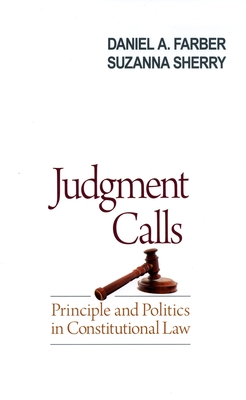
Judgment Calls : Principle and Politics in Constitutional Law
Book Details
Format
Hardback
ISBN-10
0195371208
ISBN-13
9780195371208
Publisher
Oxford University Press Inc
Imprint
Oxford University Press Inc
Country of Manufacture
GB
Country of Publication
GB
Publication Date
Jan 8th, 2009
Print length
224 Pages
Weight
460 grams
Dimensions
23.90 x 16.60 x 2.00 cms
Product Classification:
Constitutional & administrative lawJudicial review
KSh 7,950.00
Currently unavailable
0 in stock
Delivery Location
Delivery fee: Select location
Secure
Quality
Fast
Judgment Calls tackles one of the most important and controversial legal questions in contemporary America: How should judges interpret the Constitution? Our Constitution contains a great deal of language that is vague, broad, or ambiguous, making its meaning uncertain. Many people believe this uncertainty allows judges too much discretion. They suggest that constitutional adjudication is just politics in disguise, and that judges are legislators in robes who read the Constitution in accordance with their own political views. Some think that political decision making by judges is inevitable, and others think it can be restrained by "strict constructionist" theories like textualism or originalism. But at bottom, both sorts of thinkers believe that judging has to be either tightly constrained and inflexible or purely political and unfettered: There is, they argue, no middle ground. Farber and Sherry disagree, and in this book they describe and defend that middle ground. They show how judging can be--and often is--both principled and flexible. In other words, they attempt to reconcile the democratic rule of law with the recognition that judges have discretion. They explain how judicial discretion can be exercised responsibly, describe the existing constraints that guide and cabin such discretion, and suggest improvements. In exploring how constitutional adjudication works in practice (and how it can be made better), Farber and Sherry cover a wide range of topics that are relevant to their thesis and also independently important, including judicial opinion-writing, the use of precedent, the judicial selection process, the structure of the American judiciary, and the nature of legal education. They conclude with a careful look at how the Supreme Court has treated three of the most significant and sensitive constitutional issues: terrorism, abortion, and affirmative action. Timely, trenchant, and carefully argued, Judgment Calls is a welcome addition to the literature on the intersection of constitutional interpretation and American politics.
Judgment Calls tackles one of the most important and controversial legal questions in contemporary America: How should judges interpret the Constitution? Our Constitution contains a great deal of language that is vague, broad, or ambiguous, making its meaning uncertain. Many people believe this uncertainty allows judges too much discretion. They suggest that constitutional adjudication is just politics in disguise, and that judges are legislators in robes who read the Constitution in accordance with their own political views. Some think that political decision making by judges is inevitable, and others think it can be restrained by "strict constructionist" theories like textualism or originalism. But at bottom, both sorts of thinkers believe that judging has to be either tightly constrained and inflexible or purely political and unfettered: There is, they argue, no middle ground. Farber and Sherry disagree, and in this book they describe and defend that middle ground. They show how judging can be--and often is--both principled and flexible. In other words, they attempt to reconcile the democratic rule of law with the recognition that judges have discretion. They explain how judicial discretion can be exercised responsibly, describe the existing constraints that guide and cabin such discretion, and suggest improvements. In exploring how constitutional adjudication works in practice (and how it can be made better), Farber and Sherry cover a wide range of topics that are relevant to their thesis and also independently important, including judicial opinion-writing, the use of precedent, the judicial selection process, the structure of the American judiciary, and the nature of legal education. They conclude with a careful look at how the Supreme Court has treated three of the most significant and sensitive constitutional issues: terrorism, abortion, and affirmative action. Timely, trenchant, and carefully argued, Judgment Calls is a welcome addition to the literature on the intersection of constitutional interpretation and American politics.
Get Judgment Calls by Daniel A. Farber, Suzanne Sherry at the best price and quality guaranteed only at Werezi Africa's largest book ecommerce store. The book was published by Oxford University Press Inc and it has 224 pages.
Customers Who Bought This Also Bought

We the People – A History of the U.S. Constitution
KSh 5,600.00

Der Schutz von Religion und Weltanschauung durch das Grundgesetz
KSh 5,450.00
Weimar
KSh 5,400.00

The Brussels Effect
KSh 8,200.00

Slavery and Freedom in Texas – Stories from the Courtroom, 1821–1871
KSh 5,150.00
Defending Constitutional Rights
KSh 6,300.00
Federal Law and Southern Order
KSh 8,100.00
Constitutional History of Virginia
KSh 8,650.00
Defending Constitutional Rights
KSh 11,400.00

Slavery and Freedom in Texas – Stories from the Courtroom, 1821–1871
KSh 17,000.00
Signposts
KSh 16,500.00
Unintended Consequences of Constitutional Amendment
KSh 6,000.00
More by Daniel A. Farber, Suzanne Sherry

Eco-pragmatism
KSh 14,400.00
Law and Public Choice
KSh 4,200.00
Desperately Seeking Certainty
KSh 4,800.00

Eco-pragmatism
KSh 4,750.00
Beyond All Reason
KSh 7,100.00

Lincoln's Constitution
KSh 2,950.00
Desperately Seeking Certainty
KSh 14,400.00

Lincoln's Constitution
KSh 5,050.00

Law and Public Choice – A Critical Introduction
KSh 14,400.00
More in This Genre
We the People – A History of the U.S. Constitution
KSh 5,600.00
Der Schutz von Religion und Weltanschauung durch das Grundgesetz
KSh 5,450.00
Weimar
KSh 5,400.00
The Brussels Effect
KSh 8,200.00
Slavery and Freedom in Texas – Stories from the Courtroom, 1821–1871
KSh 5,150.00
Defending Constitutional Rights
KSh 6,300.00
