
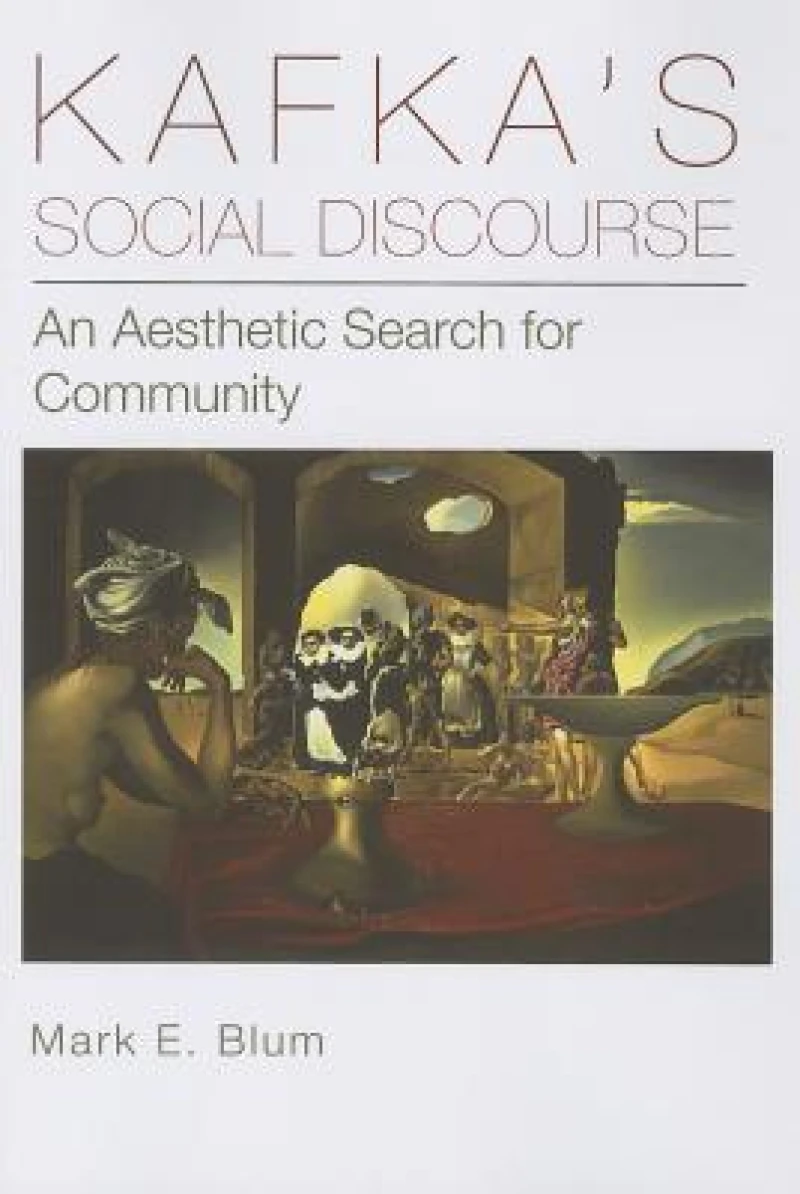
Kafka's Social Discourse : An Aesthetic Search for Community
by
Mark E. Blum
Book Details
Format
Paperback / Softback
ISBN-10
1611461464
ISBN-13
9781611461466
Publisher
Lehigh University Press
Imprint
Lehigh University Press
Country of Manufacture
GB
Country of Publication
GB
Publication Date
Aug 28th, 2013
Print length
304 Pages
Weight
440 grams
Dimensions
22.60 x 15.20 x 2.50 cms
Product Classification:
Literary studies: from c 1900 -Literary studies: fiction, novelists & prose writers
Ksh 9,950.00
Manufactured on Demand
0 in stock
Delivery Location
Delivery fee: Select location
Secure
Quality
Fast
Franz Kafka is among the most significant 20th century voices to examine the absurdity and terror posed for the individual by what his contemporary Max Weber termed "the iron cage" of society. Ferdinand Tönnies had defined the problem of finding community within society for Kafka and his peers in his 1887 book Gemeinschaft und Gesellschaft. Kafka took up this issue by focusing upon the "social discourse" of human relationships. In this book, Mark E. Blum examines Kafka's three novels, Amerika, The Trial, and The Castle, in their exploration of how community is formed or eroded in the interpersonal relations of its protagonists. Critical literature has recognized Kafka's ability to narrate the gestural moment of alienation or communion. This "social discourse" was augmented, however, by a dimension virtually no commentator has recognized—Kafka's conversation with past and present authors. Kafka encoded authors and their texts representing every century of the evolution of modernism and its societal problems, from Bunyan and Defoe, through Pope and Lessing, to Fontane and Thomas Mann. The inter-textual conversation Kafka conducted can enable us to appreciate the profound human problem of realizing community within society. Cultural historians as well as literary critics will be enriched by the evidence of these encoded cultural conversations. Kafka's "Imperial Messenger" may finally be heard in the full history of his emanations. Kafka encoded not only past authors, but painters as well. Kafka had been known as a graphic artist in his youth, and was informed by expressionism and cubism as he matured. Kafka's encodings of literature as well as fine art are not solely of the work to which he refers, but the community of authors or painters and their success or failure of community. Kafka's encodings were meant as an extra-textual readings for astute readers, but also as a lesson to his fellow authors whom he held accountable in his correspondence as cultural messengers.
Franz Kafka is among the most significant 20th century voices to examine the absurdity and terror posed for the individual by what his contemporary Max Weber termed "the iron cage" of society. Ferdinand Tönnies had defined the problem of finding community within society for Kafka and his peers in his 1887 book Gemeinschaft und Gesellschaft. Kafka took up this issue by focusing upon the "social discourse" of human relationships. In this book, Mark E. Blum examines Kafka''s three novels, Amerika, The Trial, and The Castle, in their exploration of how community is formed or eroded in the interpersonal relations of its protagonists. Critical literature has recognized Kafka''s ability to narrate the gestural moment of alienation or communion. This "social discourse" was augmented, however, by a dimension virtually no commentator has recognized—Kafka''s conversation with past and present authors. Kafka encoded authors and their texts representing every century of the evolution of modernism and its societal problems, from Bunyan and Defoe, through Pope and Lessing, to Fontane and Thomas Mann. The inter-textual conversation Kafka conducted can enable us to appreciate the profound human problem of realizing community within society. Cultural historians as well as literary critics will be enriched by the evidence of these encoded cultural conversations. Kafka''s "Imperial Messenger" may finally be heard in the full history of his emanations. Kafka encoded not only past authors, but painters as well. Kafka had been known as a graphic artist in his youth, and was informed by expressionism and cubism as he matured. Kafka''s encodings of literature as well as fine art are not solely of the work to which he refers, but the community of authors or painters and their success or failure of community. Kafka''s encodings were meant as an extra-textual readings for astute readers, but also as a lesson to his fellow authors whom he held accountable in his correspondence as cultural messengers.
Get Kafka's Social Discourse by at the best price and quality guaranteed only at Werezi Africa's largest book ecommerce store. The book was published by Lehigh University Press and it has pages.

