
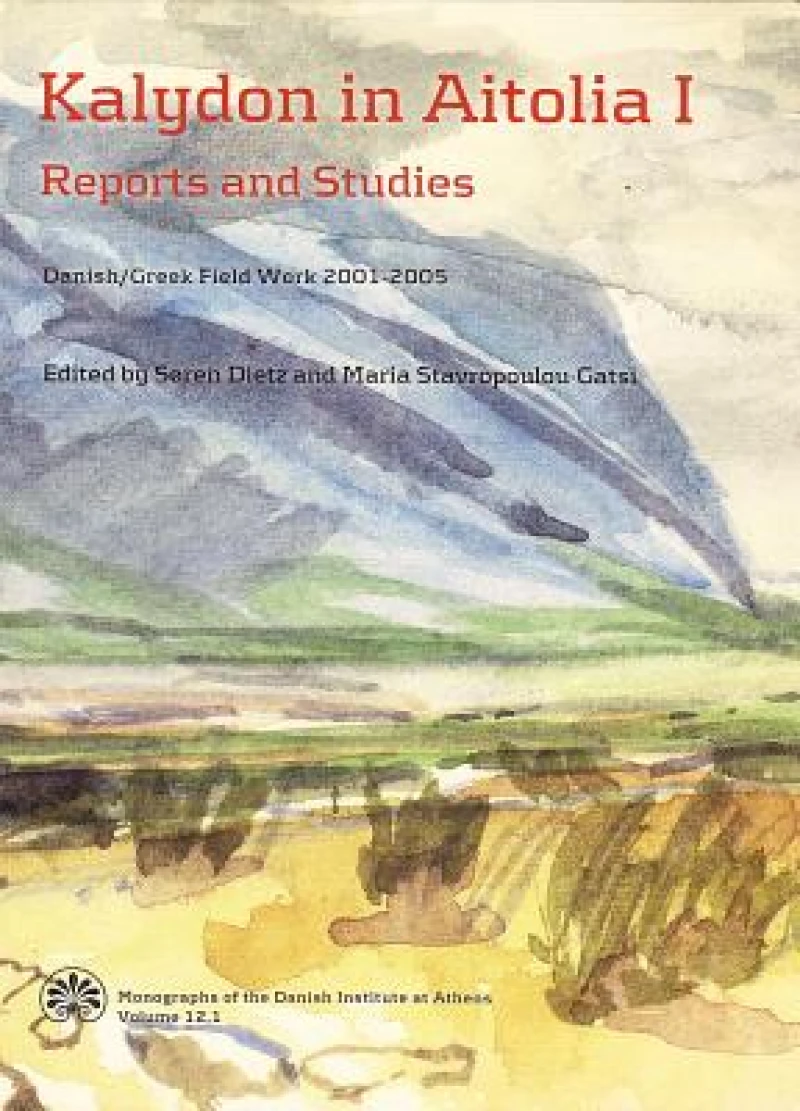
Kalydon in Aitolia I II Reports and Studies : Danish/Greek Field Work 2001-2005
Book Details
Format
Hardback or Cased Book
Book Series
Monographs of the Danish Institute at Athens
ISBN-10
8772886285
ISBN-13
9788772886282
Publisher
Aarhus University Press
Imprint
Aarhus University Press
Country of Manufacture
DK
Country of Publication
GB
Publication Date
Oct 10th, 2011
Print length
640 Pages
Weight
2,934 grams
Dimensions
27.80 x 21.30 x 5.80 cms
Product Classification:
Ancient WorldArchaeologyArchaeology
Ksh 13,350.00
Temporarily out of stock, due soon
0 in stock
Delivery Location
Delivery fee: Select location
Secure
Quality
Fast
A large-scale archaeological field project in ancient Kalydon unveils a rich tapestry of myth and urban life near Chalkis. By merging topographical surveys with strategic excavations—including athletic venues and sacred spaces—the study illuminates the city’s layout and long-established cult practices from antiquity.
In 2001 the Danish Institute at Athens commenced a large scale archaeological field project in ancient Kalydon in Aitolia. Kalydon is located around eight kilometres as the crow flies from Chalkis, on the west side of Mount Varassova in the direction of the present-day capital of Aitolia, Messolonghi. Kalydon plays a considerable role in ancient mythology as described in Homer's Iliad. For that reason, the important Sanctuary of Artemis Laphria outside the city walls and a so-called Heroon/palaestra, were excavated by a team of Danish and Greek archaeologists during the years 1926 to 1935. The new investigations are thus a continuation of an earlier Danish/Greek cooperation, this time with focus on the town itself. Various methods were used in order to examine the town itself. A surveyor initiated the topographical measurements of the city, the fortification walls and the visible remains of terrace walls and buildings. The town inside the walls was surveyed by a team, which collected and counted the objects from the surface - pottery, tiles, metals, loom weights etc. Finally, excavations concentrated on a peristyle building which was partly excavated, and a tile kiln situated in the so-called Lower Town. Larger sections of the remains on the Acropolis were excavated and a small-scale survey of the Central Town gave indications of the use of the habitation quarters. The town within the walls comprised an area of approximately 35 ha (350,000 m2). The investigations gave a good picture of the town in antiquity and of the function of the various quarters. The most important building in the Lower Town was probably the peristyle building with its colonnade and courtyard where athletic games took place. In a room in one of the corners of the building, a cult of the Anatolian goddess Cybele was established. Findings of marble sculpture, incense burners, clay figurines and lamps indicate the function of the room. The objects were found almost as they were left when the roof collapsed around the middle of the 1st century AD. On the Acropolis a shrine was already established by late Archaic times, in the late 6th century BC.
Get Kalydon in Aitolia I II Reports and Studies by at the best price and quality guaranteed only at Werezi Africa's largest book ecommerce store. The book was published by Aarhus University Press and it has pages.

