
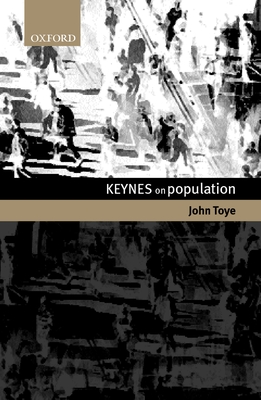
Keynes on Population
by
John Toye
Book Details
Format
Hardback
ISBN-10
0198293623
ISBN-13
9780198293620
Publisher
Oxford University Press
Imprint
Oxford University Press
Country of Manufacture
GB
Country of Publication
GB
Publication Date
Jul 6th, 2000
Print length
272 Pages
Weight
440 grams
Dimensions
22.40 x 14.60 x 2.00 cms
Product Classification:
Population & demographyEconomic theory & philosophy
KSh 31,350.00
Currently unavailable
0 in stock
Delivery Location
Delivery fee: Select location
Secure
Quality
Fast
Keynes had strong views on population questions, but this aspect of his work has been unduly neglected. Keynes on Population publishes his lectures on population, which do not appear in the Collected Writings. Toye's commentary clarifies their context and the subsequent reversals in Keynes's beliefs about population.
The topic of population is treated only lightly in the major modern biographies of John Maynard Keynes, yet Keynes himself had strong - if varying - views on the subject. For many years he maintained a neo-Malthusian view of population, based on a postulated link between population growth and deteriorating terms of trade. This led him to take up a militant stance towards ''overpopulated'' countries, notably India, China, and Egypt. Keynes on Population publishes two of John Maynard Keynes''s manuscripts not published in the Collected Writings: his Cambridge lectures on population and 1914 Oxford lecture on ''Population''. It provides a detailed commentary on the text of ''Population'' and discusses the extent of Keynes''s engagement with the Social Darwinist doctrine of the ''rapid multiplication of the unfit'' and with eugenics. It then traces the subsequent vicissitudes of his views on population and his interventions in the contemporary politics of population. These include his part in the 1920s campaign for birth control, the reversal of his neo-Malthusianism, and his eventual support for family allowances.
Get Keynes on Population by John Toye at the best price and quality guaranteed only at Werezi Africa's largest book ecommerce store. The book was published by Oxford University Press and it has 272 pages.
Customers Who Bought This Also Bought

Risky Behavior among Youths – An Economic Analysis
KSh 18,000.00

Causes and Consequences of Human Migration
KSh 18,200.00

Reproductive Rights and Wrongs
KSh 3,950.00
Global City Futures
KSh 22,600.00

Company Towns in the Americas
KSh 5,400.00
Social Reproduction and the City
KSh 22,600.00
Shadows of a Sunbelt City – The Environment, Racism, and the Knowledge Economy in Austin
KSh 15,050.00

Nuked
KSh 26,700.00

From Roots to Roses – The Autobiography of Tilda Kemplen
KSh 4,600.00

North Mississippi Homeplace
KSh 10,450.00
Almost Dead
KSh 5,450.00

Company Towns in the Americas
KSh 14,800.00
More by John Toye
The UN and Global Political Economy
KSh 4,250.00

Trade and Poor Economies
KSh 15,800.00

Does Aid Work in India?
KSh 33,000.00

The Many Faces of Socioeconomic Change
KSh 7,850.00
Aid and Power - Vol 1
KSh 14,750.00
Taxation and Economic Development
KSh 8,200.00

The Many Faces of Socioeconomic Change
KSh 4,150.00
Aid and Power - Vol 1
KSh 37,800.00

Does Aid Work in India?
KSh 9,200.00
Trade and Poor Economies
KSh 37,800.00
