
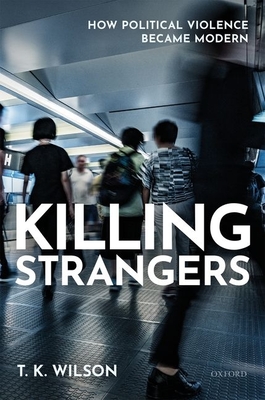
Killing Strangers : How Political Violence Became Modern
Book Details
Format
Hardback
ISBN-10
0198863500
ISBN-13
9780198863502
Publisher
Oxford University Press
Imprint
Oxford University Press
Country of Manufacture
GB
Country of Publication
GB
Publication Date
Sep 1st, 2020
Print length
274 Pages
Weight
600 grams
Dimensions
16.70 x 24.30 x 3.10 cms
KSh 6,700.00
Currently unavailable
0 in stock
Delivery Location
Delivery fee: Select location
Secure
Quality
Fast
A bewildering feature of so much contemporary political violence is its stunning impersonality, with every city centre a potential shooting gallery; every metro system a potential bomb alley. Killing Strangers explores how acts of political violence have changed over time, becoming 'unchained' from inter-personal relationships.
A bewildering feature of so much contemporary political violence is its stunning impersonality. Every major city centre becomes a potential shooting gallery; and every metro system a potential bomb alley. Victims just happen, as the saying goes, to ''be in the wrong place at the wrong time''.We accept this contemporary reality - at least to some degree. But we rarely ask: where has it come from historically? Killing Strangers tackles this question head on. It examines how such violence became ''unchained'' from inter-personal relationships. It traces the rise of such impersonal violence by examining violence in conjunction with changing social and political realities. In particular, it traces both ''push'' and ''pull'' - the ability of modern states to force the violence of their challengers into niche forms: and the disturbing new opportunities that technological changes offer to cause mayhem in fresh and original ways.Killing Strangers therefore aims to highlight the very strangeness of contemporary experience when it is viewed against a long-term perspective. Atrocities regularly capture media attention - and just as quickly fade from public view. That is both tragic - and utterly predictable. Deep down we expect no different. And that is why such atrocities must be repeated if our attention is to be re-engaged. Deep down we expect that, too.So Killing Strangers deliberately asks the very simplest of questions. How on earth did we get here?
Get Killing Strangers by T. K., Director, Handa Centre for the Study of Terrorism and Political Violence (CSTPV), Universit at the best price and quality guaranteed only at Werezi Africa's largest book ecommerce store. The book was published by Oxford University Press and it has 274 pages.
Customers Who Bought This Also Bought

Gulag Archipelago
KSh 2,700.00

Churchill
KSh 3,700.00

Modern Africa
KSh 11,500.00

Kairos
KSh 1,800.00

Spy and the Traitor
KSh 2,150.00

Crusade for Justice – The Autobiography of Ida B. Wells, Second Edition
KSh 4,050.00

Killers of the Flower Moon
KSh 2,000.00

The Origins of Totalitarianism
KSh 2,700.00

On Tyranny
KSh 2,000.00

Gandhi 1914-1948
KSh 3,950.00

Warmth of Other Suns
KSh 3,050.00

Trapped in History
KSh 2,350.00
