
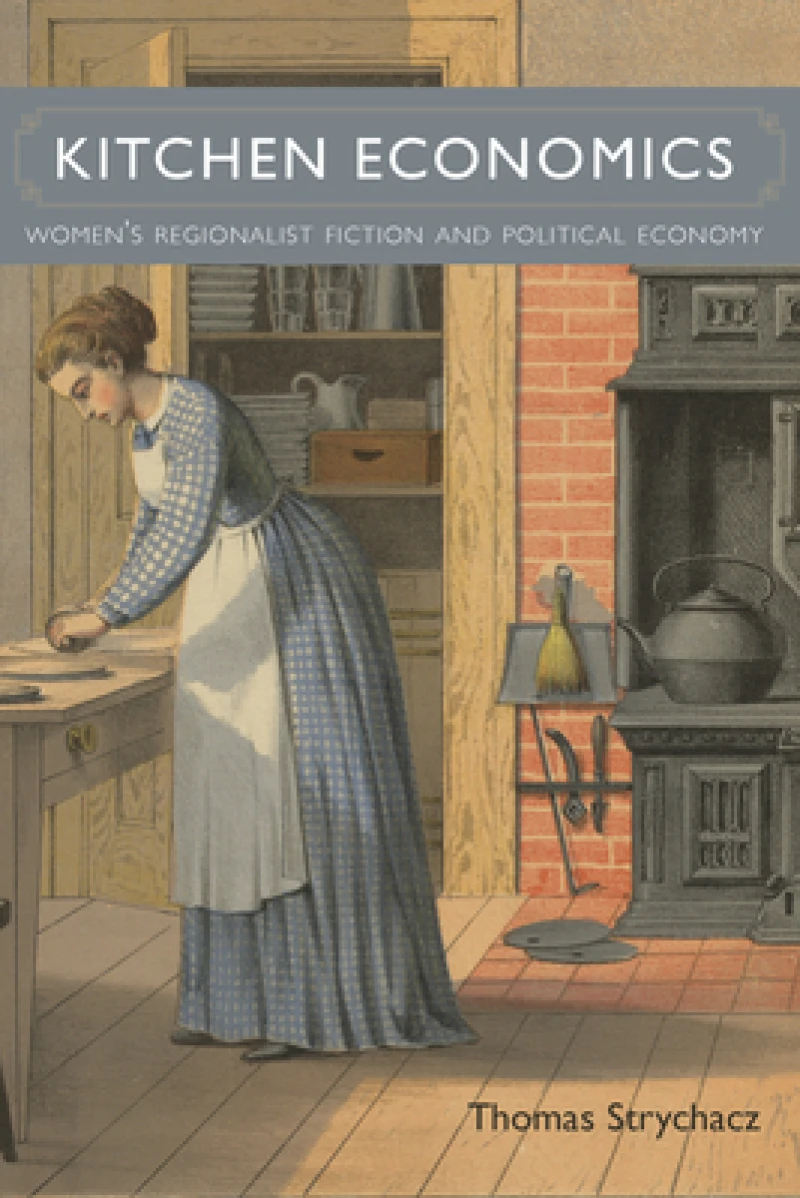
Kitchen Economics : Women's Regionalist Fiction and Political Economy
Book Details
Format
Hardback or Cased Book
Book Series
American Literary Realism & Naturalism
ISBN-10
081732058X
ISBN-13
9780817320584
Publisher
The University of Alabama Press
Imprint
The University of Alabama Press
Country of Manufacture
US
Country of Publication
GB
Publication Date
Aug 11th, 2020
Print length
232 Pages
Weight
498 grams
Dimensions
16.30 x 23.60 x 2.60 cms
Ksh 8,050.00
Werezi Extended Catalogue
0 in stock
Delivery Location
Delivery fee: Select location
Secure
Quality
Fast
Takes a new approach to the question of how female regionalist fictions represent "the economic" by situating them within traditions of classical political economic thought. The book’s approach ultimately leads us to reconsider what we mean by the term "economic".
An analysis of how nineteenth-century women regional writers represent political economic thought.
Readers of late nineteenth-century female American authors are familiar with plots, characters, and households that make a virtue of economizing. Scholars often interpret these scenarios in terms of a mythos of parsimony, frequently accompanied by a sort of elegiac republicanism whereby self-sufficiency and autonomy are put to the service of the greater good - a counterworld to the actual economic conditions of the period.
In Kitchen Economics: Women's Regionalist Fiction and Political Economy, Thomas Strychacz takes a new approach to the question of how female regionalist fictions represent "the economic" by situating them within traditions of classical political economic thought. Offering case studies of key works by Sarah Orne Jewett, Mary Wilkins Freeman, Harriet Beecher Stowe, Rose Terry Cooke, and Alice Dunbar-Nelson, this study focuses on three complex cultural fables - the island commonwealth, stadialism (or stage theory), and feeding the body politic - which found formal expression in political economic thought, made their way into endless public debates about the economic turmoil of the late nineteenth century, and informed female authors. These works represent counterparts, not counterworlds, to modernity; and their characteristic stance is captured in the complex trope of feminaeconomica.
This approach ultimately leads us to reconsider what we mean by the term "economic," for the emphasis of contemporary neoclassical economics on economic agents given over to infinite wants and complete self-interest has caused the "sufficiency" and "common good" models of female regionalist authors to be misinterpreted and misvalued. These fictions are nowhere more pertinent to modernity than in their alliance with today's important alternative economic discourses.
Readers of late nineteenth-century female American authors are familiar with plots, characters, and households that make a virtue of economizing. Scholars often interpret these scenarios in terms of a mythos of parsimony, frequently accompanied by a sort of elegiac republicanism whereby self-sufficiency and autonomy are put to the service of the greater good - a counterworld to the actual economic conditions of the period.
In Kitchen Economics: Women's Regionalist Fiction and Political Economy, Thomas Strychacz takes a new approach to the question of how female regionalist fictions represent "the economic" by situating them within traditions of classical political economic thought. Offering case studies of key works by Sarah Orne Jewett, Mary Wilkins Freeman, Harriet Beecher Stowe, Rose Terry Cooke, and Alice Dunbar-Nelson, this study focuses on three complex cultural fables - the island commonwealth, stadialism (or stage theory), and feeding the body politic - which found formal expression in political economic thought, made their way into endless public debates about the economic turmoil of the late nineteenth century, and informed female authors. These works represent counterparts, not counterworlds, to modernity; and their characteristic stance is captured in the complex trope of feminaeconomica.
This approach ultimately leads us to reconsider what we mean by the term "economic," for the emphasis of contemporary neoclassical economics on economic agents given over to infinite wants and complete self-interest has caused the "sufficiency" and "common good" models of female regionalist authors to be misinterpreted and misvalued. These fictions are nowhere more pertinent to modernity than in their alliance with today's important alternative economic discourses.
Get Kitchen Economics by at the best price and quality guaranteed only at Werezi Africa's largest book ecommerce store. The book was published by The University of Alabama Press and it has pages.

