
Konstantin Melnikov and his House
by
Fritz Barth
Book Details
Format
Hardback or Cased Book
ISBN-10
3936681902
ISBN-13
9783936681901
Publisher
Edition Axel Menges
Imprint
Edition Axel Menges
Country of Manufacture
DE
Country of Publication
GB
Publication Date
May 1st, 2015
Print length
64 Pages
Weight
558 grams
Dimensions
29.20 x 22.10 x 1.40 cms
Product Classification:
Individual architects & architectural firms
Ksh 5,200.00
Werezi Extended Catalogue
0 in stock
Delivery Location
Delivery fee: Select location
Secure
Quality
Fast
Konstantin Melnikov (18901974) is unquestionably one of the outstanding architects of the 20th century in spite of the fact that he fell silent early, leaving behind only limited work that was insufficiently publicized, and restricted almost exclusively to Moscow, the city of his birth in which he spent nearly his entire life and which did not appreciate him. He was raised in humble circumstances, but enjoyed an excellent education. Beginning in the mid-1920s, after the turmoil that followed the war, revolution and civil war, his career soared at almost meteoric speed as he took the lead in the young Soviet architecture movement with completely autonomous, highly artistic buildings that were free from dogmatism of any kind. Even more rapid than his rise to fame was his downfall: Treated with general hostility, he was unable to defend himself against the accusation of formalism when Stalin put an end to architectural ventures and experiments around the mid-1930s. He was expelled from the architects' association and was banned from practicing as an architect for the remaining four decades of his life. In the late 1920s, at the peak of his career, he had the opportunity to build a house for himself and his family in Moscow, in which he was then able to live until the end of his life. This house, a memorable symbiosis of almost peasant-like simplicity and extreme radicalness, is one of the most impressive, surprising and probably most enigmatic works produced by 20th-century architecture. Its simplicity is only outward; in reality this is a highly complex work which links together the elements of architecture explicitly and inextricably, which takes a clear and completely autonomous stand and which, in a way that little else has done, raises the question as to the nature of genuinely architectonic thinking. In essayistic form the book attempts to follow the paths laid out in the architect's work from the perspective of an architect.
Konstantin Melnikov (1890–1974) is unquestionably one of the outstanding architects of the 20th century—in spite of the fact that he fell silent early, leaving behind only limited work that was insufficiently publicized, and restricted almost exclusively to Moscow, the city of his birth in which he spent nearly his entire life and which did not appreciate him. He was raised in humble circumstances, but enjoyed an excellent education. Beginning in the mid-1920s, after the turmoil that followed the war, revolution and civil war, his career soared at almost meteoric speed as he took the lead in the young Soviet architecture movement with completely autonomous, highly artistic buildings that were free from dogmatism of any kind. Even more rapid than his rise to fame was his downfall: Treated with general hostility, he was unable to defend himself against the accusation of formalism when Stalin put an end to architectural ventures and experiments around the mid-1930s. He was expelled from the architects' association and was banned from practicing as an architect for the remaining four decades of his life.
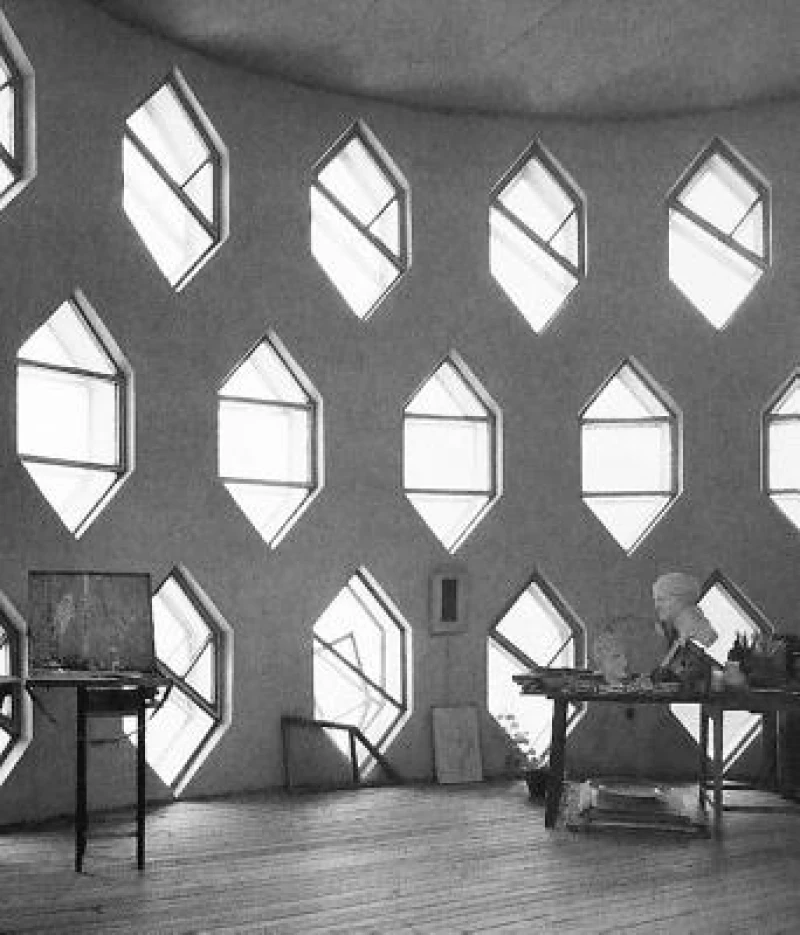
In the late 1920s, at the peak of his career, he had the opportunity to build a house for himself and his family in Moscow, in which he was then able to live until the end of his life. This house, a memorable symbiosis of almost peasantlike simplicity and extreme radicalness, is one of the most impressive, surprising and probably most enigmatic works produced by 20th-century architecture. Its simplicity is only outward; in reality this is a highly complex work which links together the elements of architecture explicitly and inextricably, which takes a clear and completely autonomous stand and which, in a way that little else has done, raises the question as to the nature of genuinely architectonic thinking. In essayistic form the book attempts to follow the paths laid out in the architect’s work from the perspective of an architect.
In the late 1920s, at the peak of his career, he had the opportunity to build a house for himself and his family in Moscow, in which he was then able to live until the end of his life. This house, a memorable symbiosis of almost peasantlike simplicity and extreme radicalness, is one of the most impressive, surprising and probably most enigmatic works produced by 20th-century architecture. Its simplicity is only outward; in reality this is a highly complex work which links together the elements of architecture explicitly and inextricably, which takes a clear and completely autonomous stand and which, in a way that little else has done, raises the question as to the nature of genuinely architectonic thinking. In essayistic form the book attempts to follow the paths laid out in the architect’s work from the perspective of an architect.
Get Konstantin Melnikov and his House by at the best price and quality guaranteed only at Werezi Africa's largest book ecommerce store. The book was published by Edition Axel Menges and it has pages.

