
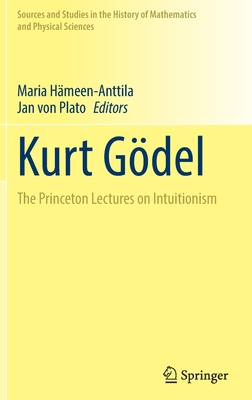
Kurt Gödel : The Princeton Lectures on Intuitionism
2021 ed.
Book Details
Format
Hardback
ISBN-10
3030872955
ISBN-13
9783030872953
Edition
2021 ed.
Publisher
Springer Nature Switzerland AG
Imprint
Springer Nature Switzerland AG
Country of Manufacture
GB
Country of Publication
GB
Publication Date
Dec 16th, 2021
Print length
133 Pages
Weight
366 grams
Dimensions
24.10 x 16.50 x 1.50 cms
KSh 18,000.00
Currently unavailable
0 in stock
Delivery Location
Delivery fee: Select location
Secure
Quality
Fast
Gödel then went on to attack Hilbert's first and second Paris problems, namely Cantor's continuum problem about the type of infinity of the real numbers, and the freedom from contradiction of the theory of real numbers.
Paris of the year 1900 left two landmarks: the Tour Eiffel, and David Hilbert''s celebrated list of twenty-four mathematical problems presented at a conference opening the new century. Kurt Gödel, a logical icon of that time, showed Hilbert''s ideal of complete axiomatization of mathematics to be unattainable. The result, of 1931, is called Gödel''s incompleteness theorem. Gödel then went on to attack Hilbert''s first and second Paris problems, namely Cantor''s continuum problem about the type of infinity of the real numbers, and the freedom from contradiction of the theory of real numbers. By 1963, it became clear that Hilbert''s first question could not be answered by any known means, half of the credit of this seeming faux pas going to Gödel. The second is a problem still wide open. Gödel worked on it for years, with no definitive results; The best he could offer was a start with the arithmetic of the entire numbers.
This book, Gödel''s lectures at the famous Princeton Institute for Advanced Study in 1941, shows how far he had come with Hilbert''s second problem, namely to a theory of computable functionals of finite type and a proof of the consistency of ordinary arithmetic. It offers indispensable reading for logicians, mathematicians, and computer scientists interested in foundational questions. It will form a basis for further investigations into Gödel''s vast Nachlass of unpublished notes on how to extend the results of his lectures to the theory of real numbers. The book also gives insights into the conceptual and formal work that is needed for the solution of profound scientific questions, by one of the central figures of 20th century science and philosophy.
Get Kurt Gödel by Jan von Plato at the best price and quality guaranteed only at Werezi Africa's largest book ecommerce store. The book was published by Springer Nature Switzerland AG and it has 133 pages.
Customers Who Bought This Also Bought

Thus Spoke Zarathustra
KSh 2,000.00

On War
KSh 1,200.00

Ecce Homo
KSh 1,800.00

On War
KSh 4,500.00

Kierkegaard
KSh 1,800.00

On Art, Religion, and the History of Philosophy
KSh 3,100.00

Critique Of Pure Reason
KSh 2,700.00

Grounding for the Metaphysics of Morals
KSh 2,700.00

Critique of Pure Reason, Abridged
KSh 3,600.00

Discourse on Political Economy and The Social Contract
KSh 1,800.00

Discourse on the Origin of Inequality
KSh 2,150.00

Selected Letters of Friedrich Nietzsche
KSh 4,700.00
