
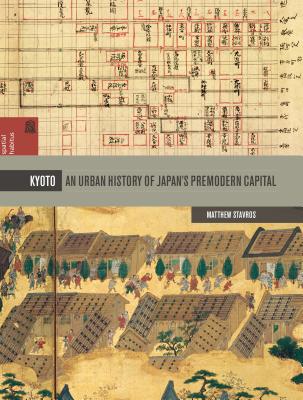
Kyoto : An Urban History of Japan's Premodern Capital
Book Details
Format
Paperback / softback
ISBN-10
0824867882
ISBN-13
9780824867881
Publisher
University of Hawai'i Press
Imprint
University of Hawai'i Press
Country of Manufacture
US
Country of Publication
GB
Publication Date
Jun 30th, 2016
Print length
256 Pages
Weight
570 grams
Dimensions
17.80 x 23.40 x 1.80 cms
KSh 4,500.00
Publisher Out of Stock
0 in stock
Delivery Location
Delivery fee: Select location
Secure
Quality
Fast
Kyoto was Japan's political and cultural capital for more than a millennium before the dawn of the modern era. Through a synthesis of textual, pictorial, and archeological sources, this work sheds light on Kyoto's premodern urban landscape with the aim of opening up new ways of thinking about key aspects of premodern Japanese history.
Kyoto was Japan’s political and cultural capital for more than a millennium before the dawn of the modern era. Until about the fifteenth century, it was also among the world’s largest cities and, as the eastern terminus of the Silk Road, it was a place where the political, artistic, and religious currents of Asia coalesced and flourished. Despite these and many other traits that make Kyoto a place of both Japanese and world historical significance, the physical appearance of the premodern city remains largely unknown. Through a synthesis of textual, pictorial, and archeological sources, this work attempts to shed light on Kyoto’s premodern urban landscape with the aim of opening up new ways of thinking about key aspects of premodern Japanese history.
The book begins with an examination of Kyoto’s highly idealized urban plan (adapted from Chinese models in the eighth century) and the reasons behind its eventual failure. The formation of the suburbs of Kamigy? and Shimogy? is compared to the creation of large exurban temple-palace complexes by retired emperors from the late eleventh century. Each, it is argued, was a material manifestation of the advancement of privatized power that inspired a medieval discourse aimed at excluding “outsiders.” By examining this discourse, a case is made that medieval power holders, despite growing autonomy, continued to see the emperor and classical state system as the ultimate sources of political legitimacy. This sentiment was shared by the leaders of the Ashikaga shogunate, who established their headquarters in Kyoto in 1336. The narrative examines how these warrior leaders interacted with the capital’s urban landscape, revealing a surprising degree of deference to classical building protocols and urban codes. Remaining chapters look at the dramatic changes that took place during the Age of Warring States (1467–1580s) and Kyoto’s postwar revitalization under the leadership of Oda Nobunaga and Toyotomi Hideyoshi. Nobunaga’s construction of Nij? Castle in 1569 transformed Kyoto’s fundamental character and, as Japan’s first castle town, it set an example soon replicated throughout the archipelago. In closing, the book explores how Hideyoshi—like so many before him, yet with much greater zeal—used monumentalism to co-opt and leverage the authority of Kyoto’s traditional institutions.
Richly illustrated with original maps and diagrams, Kyoto is a panoramic examination of space and architecture spanning eight centuries. It narrates a history of Japan’s premodern capital relevant to the fields of institutional history, material culture, art and architectural history, religion, and urban planning. Students and scholars of Japan will be introduced to new ways of thinking about old historical problems while readers interested in the cities and architecture of East Asia and beyond will benefit from a novel approach that synthesizes a wide variety of sources.
The book begins with an examination of Kyoto’s highly idealized urban plan (adapted from Chinese models in the eighth century) and the reasons behind its eventual failure. The formation of the suburbs of Kamigy? and Shimogy? is compared to the creation of large exurban temple-palace complexes by retired emperors from the late eleventh century. Each, it is argued, was a material manifestation of the advancement of privatized power that inspired a medieval discourse aimed at excluding “outsiders.” By examining this discourse, a case is made that medieval power holders, despite growing autonomy, continued to see the emperor and classical state system as the ultimate sources of political legitimacy. This sentiment was shared by the leaders of the Ashikaga shogunate, who established their headquarters in Kyoto in 1336. The narrative examines how these warrior leaders interacted with the capital’s urban landscape, revealing a surprising degree of deference to classical building protocols and urban codes. Remaining chapters look at the dramatic changes that took place during the Age of Warring States (1467–1580s) and Kyoto’s postwar revitalization under the leadership of Oda Nobunaga and Toyotomi Hideyoshi. Nobunaga’s construction of Nij? Castle in 1569 transformed Kyoto’s fundamental character and, as Japan’s first castle town, it set an example soon replicated throughout the archipelago. In closing, the book explores how Hideyoshi—like so many before him, yet with much greater zeal—used monumentalism to co-opt and leverage the authority of Kyoto’s traditional institutions.
Richly illustrated with original maps and diagrams, Kyoto is a panoramic examination of space and architecture spanning eight centuries. It narrates a history of Japan’s premodern capital relevant to the fields of institutional history, material culture, art and architectural history, religion, and urban planning. Students and scholars of Japan will be introduced to new ways of thinking about old historical problems while readers interested in the cities and architecture of East Asia and beyond will benefit from a novel approach that synthesizes a wide variety of sources.
Get Kyoto by Matthew Stavros at the best price and quality guaranteed only at Werezi Africa's largest book ecommerce store. The book was published by University of Hawai'i Press and it has 256 pages.
Customers Who Bought This Also Bought
Soft City
KSh 5,750.00
Contemporary Latin American Architecture
KSh 7,900.00
Contemporary Latin American Architecture
KSh 30,950.00

Night Rules
KSh 30,950.00
Sprawling Places
KSh 6,750.00
Cities That Think like Planets – Complexity, Resilience, and Innovation in Hybrid Ecosystems
KSh 12,400.00

Charleston and Savannah – The Rise, Fall, and Reinvention of Two Rival Cities
KSh 6,800.00

Inclusive Participation in Planning in the UK
KSh 30,950.00

Reinventing the River City
KSh 17,500.00

Retrofitting Sprawl
KSh 7,000.00

Avenues of Translation – The City in Iberian and Latin American Writing
KSh 22,300.00
Well-Intentioned Whiteness
KSh 6,650.00
