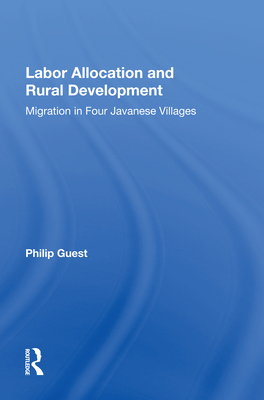
Labor Allocation and Rural Development : Migration In Four Javanese Villages
by
Philip Guest
Book Details
Format
Paperback / softback
ISBN-10
036716308X
ISBN-13
9780367163082
Publisher
Taylor & Francis Ltd
Imprint
Routledge
Country of Manufacture
GB
Country of Publication
GB
Publication Date
Jun 13th, 2023
Print length
256 Pages
Weight
453 grams
Product Classification:
Society and culture: generalSociety & culture: generalSociology
KSh 8,450.00
Currently unavailable
0 in stock
Delivery Location
Delivery fee: Select location
Secure
Quality
Fast
By integrating migration research in a comprehensive framework of labour allocation at household and village levels, this study shows how migration factors are crucial in understanding the transformations of rural communities in developing countries. Data collected in 4 villages within a wet rice-growing area of Central Java, Indonesia, are used to examine why some villages and households contribute a greater share of migrants than others. The decision to migrate is located within the constraints and opportunities of local labour markets, and migration is treated as one among many alternatives for allocating the labour of household members. The type of labour allocation choices made is lined to the demographic structure of households, the social position of the household, and the employment opportunities available within the community. These factors are then related to processes of rural development.
Get Labor Allocation and Rural Development by Philip Guest at the best price and quality guaranteed only at Werezi Africa's largest book ecommerce store. The book was published by Taylor & Francis Ltd and it has 256 pages.
Customers Who Bought This Also Bought

Africa Dances
KSh 2,700.00

Its Our Turn to Eat
KSh 2,350.00

Stranger Faces
KSh 2,500.00

The 48 Laws Of Power
KSh 3,600.00

Wild Seed
KSh 2,350.00

Patternmaster
KSh 2,350.00

Clay's Ark
KSh 2,350.00

Mind of My Mind
KSh 2,350.00

Clay''s Ark
KSh 2,000.00

Mind of My Mind
KSh 2,000.00

Biased
KSh 2,150.00

Identity
KSh 2,150.00