
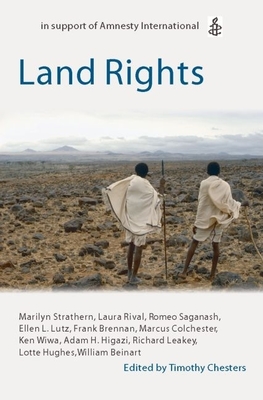
Land Rights : Oxford Amnesty Lectures
Book Details
Format
Paperback / softback
Book Series
Oxford Amnesty Lectures
ISBN-10
0199545103
ISBN-13
9780199545100
Publisher
Oxford University Press
Imprint
Oxford University Press
Country of Manufacture
GB
Country of Publication
GB
Publication Date
Jan 15th, 2009
Print length
240 Pages
Weight
180 grams
Dimensions
19.60 x 13.20 x 1.40 cms
KSh 11,500.00
Currently unavailable
0 in stock
Delivery Location
Delivery fee: Select location
Secure
Quality
Fast
What do indigenous people mean when they invoke their collective right to land? How are national governments, and international law, to arbitrate between them and property-owners and corporations? Experts from diverse fields and organisations - anthropologists, historians, lawyers, conservationists, and campaigners - debate 'Land Rights'.
Indigenous peoples and governments, industrialists and ecologists all use - or have at some stage to confront - the language of land rights. That language raises as many questions as it answers. Rights of the land or rights to the land? Rights of the individual or rights of the community? Even accepting that such rights exist, how to arbitrate between competing claims to land? Spanning as they do a wide range of intellectual territory, and their spheres of interest or activity ranging geographically from the Niger Delta to Papua New Guinea, from Quebec to the Eastern Cape, the contributors to this volume move across a range of different, and at times contradictory, approaches to land rights. Marilyn Strathern explores the divergent anthropologies of land, specifically regarding the equation of land and property. Cree lawyer and spokesman Romeo Saganash and Frank Brennan, an Australian lawyer and priest, explore the legal framework for land claims. The UN''s International Decade of the Rights of Indigenous People recently ended in the failure of negotiating govemnents to accommodate, within international law, a ''collective'' right to land. It is only by acknowledging this collective right to self-determination, both argue, that governments can come to terms with their indigenous populations and their own colonial past. Against the pleas of Brennan and Saganash, the Kenyan Richard Leakey, whose own history and politics is indissociable from that past, questions the whole notion of ''indigeneity''. The campaigner Ken Wiwa speaks too of the difficulties of redressing historical injusticeis, especially in a region - the Niger Delta - where the indigenous Ogoni have no written record of their losses. Finally William Beinart, a historian and advisor to the South African government, outlines some of the practical difficulties of land reform in that country.
Get Land Rights by Timothy Chesters at the best price and quality guaranteed only at Werezi Africa's largest book ecommerce store. The book was published by Oxford University Press and it has 240 pages.
Customers Who Bought This Also Bought

How Africa Works
KSh 3,050.00
Development as Freedom
KSh 2,900.00

How Africa Works
KSh 4,500.00

Anti-Politics Machine
KSh 3,750.00
We Are Not Able to Live in the Sky
KSh 3,400.00
Apostles of Development
KSh 5,600.00
The Bottom Billion
KSh 2,500.00
Indigenous Knowledge Inquiries
KSh 6,600.00

Why Africa is poor
KSh 2,350.00

Historical Dictionary of Aid and Development Organizations
KSh 12,050.00

Contemporary Latin American Architecture
KSh 7,900.00
The Poverty of Growth
KSh 2,900.00
