
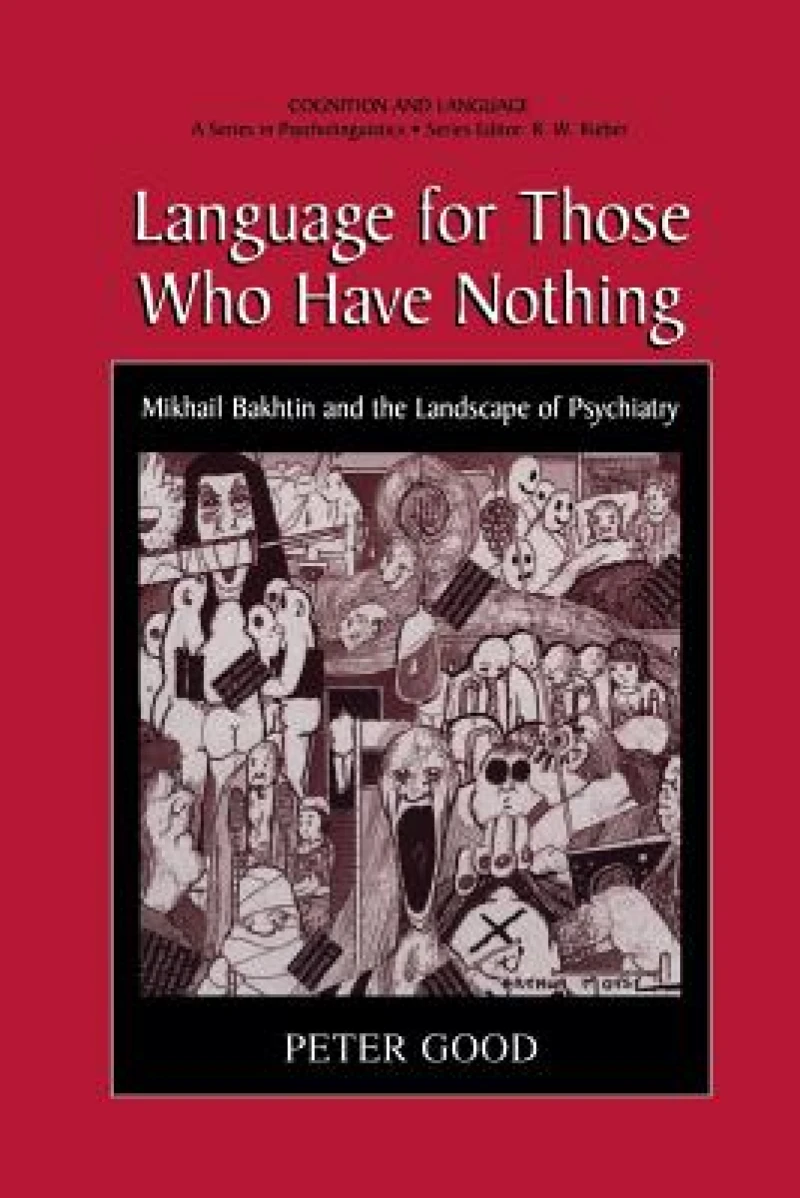
Language for Those Who Have Nothing : Mikhail Bakhtin and the Landscape of Psychiatry
Softcover reprint of the original 1st ed. 2001
by
Peter Good
Book Details
Format
Paperback / Softback
ISBN-10
1475774451
ISBN-13
9781475774450
Edition
Softcover reprint of the original 1st ed. 2001
Publisher
Springer-Verlag New York Inc.
Imprint
Springer-Verlag New York Inc.
Country of Manufacture
US
Country of Publication
GB
Publication Date
Mar 30th, 2013
Print length
242 Pages
Ksh 16,200.00
Werezi Extended Catalogue
0 in stock
Delivery Location
Delivery fee: Select location
Secure
Quality
Fast
By exploring the context of psychiatry's unofficial voices: its terminology, jokes, parodies, and everyday narratives, the clinical landscape is shown to rely heavily on unofficial dialogues in order to safeguard an official identity.
The aim of Language for those who have Nothing is to think psychiatry through the writings of Mikhail Bakhtin. Using the concepts of Dialogism and Polyphony, the Carnival and the Chronotope, a novel means of navigating the clinical landscape is developed.
Bakhtin offers language as a social phenomenon and one that is fully embodied. Utterances are shown to be alive and enfleshed and their meanings realised in the context of given social dimensions. The organisation of this book corresponds with carnival practices of taking the high down to the low before replenishing its meaning anew. Thus early discussions of official language and the chronotope become exposed to descending levels of analysis and emphasis.
Patients and practitioners are shown to occupy an entirely different spatio-temporal topography. These chronotopes have powerful borders and it is necessary to use the Carnival powers of cunning and deception in order to enter and to leave them. The book provides an overview of practitioners who have attempted such transgression and the author records his own unnerving experience as a pseudopatient. By exploring the context of psychiatry''s unofficial voices: its terminology, jokes, parodies, and everyday narratives, the clinical landscape is shown to rely heavily on unofficial dialogues in order to safeguard an official identity.
Bakhtin offers language as a social phenomenon and one that is fully embodied. Utterances are shown to be alive and enfleshed and their meanings realised in the context of given social dimensions. The organisation of this book corresponds with carnival practices of taking the high down to the low before replenishing its meaning anew. Thus early discussions of official language and the chronotope become exposed to descending levels of analysis and emphasis.
Patients and practitioners are shown to occupy an entirely different spatio-temporal topography. These chronotopes have powerful borders and it is necessary to use the Carnival powers of cunning and deception in order to enter and to leave them. The book provides an overview of practitioners who have attempted such transgression and the author records his own unnerving experience as a pseudopatient. By exploring the context of psychiatry''s unofficial voices: its terminology, jokes, parodies, and everyday narratives, the clinical landscape is shown to rely heavily on unofficial dialogues in order to safeguard an official identity.
Get Language for Those Who Have Nothing by at the best price and quality guaranteed only at Werezi Africa's largest book ecommerce store. The book was published by Springer-Verlag New York Inc. and it has pages.

