
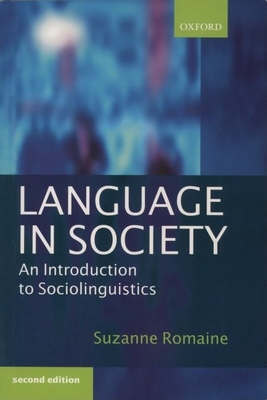
Book Details
Format
Paperback / softback
ISBN-10
0198731922
ISBN-13
9780198731924
Edition
2 Revised edition
Publisher
Oxford University Press
Imprint
Oxford University Press
Country of Manufacture
GB
Country of Publication
GB
Publication Date
Oct 5th, 2000
Print length
288 Pages
Weight
444 grams
Dimensions
23.20 x 15.60 x 1.70 cms
Product Classification:
Sociolinguistics
KSh 6,650.00
Currently unavailable
0 in stock
Delivery Location
Delivery fee: Select location
Secure
Quality
Fast
Suzanne Romaine provides an introduction to the field of sociolinguistics and emphasizes the constant interaction between society and language, discussing both traditional and recent issues including: language and social class, language and gender, language and education, and pidgins and creoles.
Why have 1500 separate languages developed in the Pacific region? Why do Danes understand Norwegians better than Norwegians understand Danish? Is Ebonics a language or a dialect? Linguistics tends to ignore the relationship between languages and the societies in which they are spoken, while sociology generally overlooks the role of language in the constitution of society. In this book Suzanne Romaine provides a clear, lively, and accessible introduction to the field of sociolinguistics and emphasizes the constant interaction between society and language, discussing both traditional and recent issues including: language and social class, language and gender, language and education, and pidgins and creoles. The text shows how our linguistic choices are motivated by social factors, and how certain ways of speaking come to be vested with symbolic value and includes examples drawing on studies of cultures and languages all over the world. This new edition incorporates new material on current issues in the study of gender as well as other topics such as the linguistic dimension to the ethnic conflict in the Balkans, and the controversy over Ebonics in the United States.
Get Language in Society by Suzanne Romaine at the best price and quality guaranteed only at Werezi Africa's largest book ecommerce store. The book was published by Oxford University Press and it has 288 pages.
Customers Who Bought This Also Bought

Decolonising the Mind
KSh 4,700.00

Cultish
KSh 2,350.00

Digital Plurilingual Pedagogies in Teacher Education
KSh 27,900.00

Linguistic Landscape Studies of Global Chinese
KSh 30,800.00
Voice of Deliverance
KSh 6,450.00

Romania Africana
KSh 32,750.00

Second Language Learning and the COVID-19 Pandemic
KSh 21,250.00

Literacy Mediation
KSh 30,950.00

That''s Not What I Meant!
KSh 1,850.00

Construction Grammar and Sociolinguistic Theory
KSh 20,450.00

The Climate Turn in Language Teaching
KSh 3,250.00
The Cambridge Handbook of Sociolinguistics
KSh 30,100.00
More by Suzanne Romaine

Communicating Gender
KSh 30,950.00
Vanishing Voices
KSh 7,800.00

Socio-Historical Linguistics
KSh 6,300.00

Vanishing Voices
KSh 3,900.00

Pidgin and Creole Languages
KSh 37,800.00

Pidgin and Creole Languages
KSh 12,600.00

Communicating Gender
KSh 13,550.00
Socio-Historical Linguistics
KSh 8,000.00
Language, Education, and Development
KSh 36,050.00
