
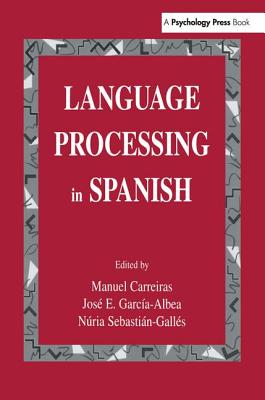
Language Processing in Spanish
Book Details
Format
Paperback / softback
ISBN-10
1138974307
ISBN-13
9781138974302
Publisher
Taylor & Francis Ltd
Imprint
Psychology Press Ltd
Country of Manufacture
GB
Country of Publication
GB
Publication Date
Aug 26th, 2016
Print length
384 Pages
Weight
453 grams
Product Classification:
Child & developmental psychologyChild, developmental and lifespan psychology
KSh 10,100.00
Currently unavailable
0 in stock
Delivery Location
Delivery fee: Select location
Secure
Quality
Fast
This book presents a set of contributions to the current flow of psycholinguistic research, with new and challenging data gathered from Spanish that may illuminate issues about the generality of language processing models. Although it is possible to find a considerable amount of papers on psycholinguistic research with the Spanish language published in English-speaking journals, unfortunately, the scientific community does not have access to an overview of psycholinguistics in Spain. This book overcomes these limitations because it brings together state-of-the-art descriptions of the research and theory of the different subareas of psycholinguistics currently being studied in Spain.
Spanish, the third most widely-used language in the world, differs from English in a number of important respects. Since English has been predominant in psycholinguistic research, contrasting properties of Spanish may help to test the generality of language processing mechanisms and to refine their description. The set of contrasting features considered in this book includes acoustical and syllabic transparency, shallow orthography, a much richer morphology, flexibility in word order, less variability in intonational contours, and the existence of null pronominal subjects for inflected verbs. There are also interesting contrasts in the frequency of different linguistic units, whose impact on language processing is also evaluated. One of the main lines of argument throughout this book deals with the tension between universality and variation as a way of characterizing the functioning of language capacities and processes.
The variety of topics covered by this book ranges from one end of the spectrum of language related behavior to the other: speech perception, lexical access in word recognition, relations between phonological and orthographic representations, sentence processing, discourse comprehension, and language production. All chapters focus on questions of general interest within each topic, and in most cases they appeal to one particular feature of the Spanish language that is relevant for a given question. Most chapters show the indisputable importance of crosslinguistic research in psycholinguistics to improve understanding on whether universal cognitive mechanisms and language specific routines underlie the ability of understanding and producing language.
Spanish, the third most widely-used language in the world, differs from English in a number of important respects. Since English has been predominant in psycholinguistic research, contrasting properties of Spanish may help to test the generality of language processing mechanisms and to refine their description. The set of contrasting features considered in this book includes acoustical and syllabic transparency, shallow orthography, a much richer morphology, flexibility in word order, less variability in intonational contours, and the existence of null pronominal subjects for inflected verbs. There are also interesting contrasts in the frequency of different linguistic units, whose impact on language processing is also evaluated. One of the main lines of argument throughout this book deals with the tension between universality and variation as a way of characterizing the functioning of language capacities and processes.
The variety of topics covered by this book ranges from one end of the spectrum of language related behavior to the other: speech perception, lexical access in word recognition, relations between phonological and orthographic representations, sentence processing, discourse comprehension, and language production. All chapters focus on questions of general interest within each topic, and in most cases they appeal to one particular feature of the Spanish language that is relevant for a given question. Most chapters show the indisputable importance of crosslinguistic research in psycholinguistics to improve understanding on whether universal cognitive mechanisms and language specific routines underlie the ability of understanding and producing language.
Get Language Processing in Spanish by Jos‚ E. Garc¡a-Albea at the best price and quality guaranteed only at Werezi Africa's largest book ecommerce store. The book was published by Taylor & Francis Ltd and it has 384 pages.
Customers Who Bought This Also Bought

The Anxious Generation
KSh 2,000.00

Restoring Childhood
KSh 3,050.00

Bible old testament bindup_8x8
KSh 2,450.00
The Einstein Syndrome
KSh 3,200.00

Restoring Childhood
KSh 4,500.00

Free to Learn
KSh 3,050.00
Key Issues in Childhood and Youth Studies
KSh 8,000.00

Key Issues in Childhood and Youth Studies
KSh 30,950.00

Outsmart Anxiety
KSh 4,700.00

How Children Succeed
KSh 3,400.00
Helping Children Succeed
KSh 3,050.00
The Life and Creative Works of Paulo Coelho
KSh 21,600.00
