Cart 0
Latent Variable Modeling Using R
Click to zoom

Share this book

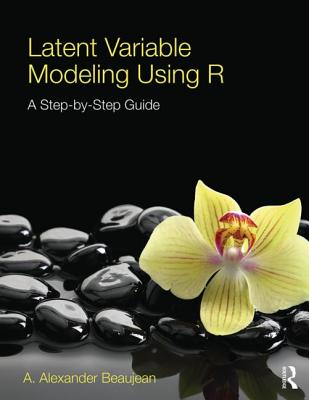
Latent Variable Modeling Using R : A Step-by-Step Guide

Book Details

Format Paperback / Softback
ISBN-10 1848726996
ISBN-13 9781848726994
Publisher Taylor & Francis Ltd
Imprint Routledge
Country of Manufacture GB
Country of Publication GB
Publication Date May 6th, 2014
Print length 218 Pages
Weight 564 grams
Dimensions 21.40 x 28.20 x 1.20 cms
Ksh 9,600.00
Werezi Extended Catalogue Delivery in 14 days

Delivery Location

Delivery fee: Select location

Delivery in 14 days

Secure
Quality
Fast

This accessible guide focuses on lavaan to help readers understand latent variable model (LVMs) and their analysis in R. The reasoning behind the syntax selected is provided along with multidisciplinary examples. Chapters feature key terms, interpretations of output, examples of how to write about the results, exercises with solutions, and related readings. The website provides the data for the examples and exercises and R syntax so readers can replicate the analyses. Readers learn to enter data into R and obtain and interpret values. Written for R and LVM novices, the book prepares students and researchers to write about and interpret LVM results obtained in R.

This step-by-step guide is written for R and latent variable model (LVM) novices. Utilizing a path model approach and focusing on the lavaan package, this book is designed to help readers quickly understand LVMs and their analysis in R. The author reviews the reasoning behind the syntax selected and provides examples that demonstrate how to analyze data for a variety of LVMs.  Featuring examples applicable to psychology, education, business, and other social and health sciences, minimal text is devoted to theoretical underpinnings. The material is presented without the use of matrix algebra. As a whole the book prepares readers to write about and interpret LVM results they obtain in R.

Each chapter features background information, boldfaced key  terms defined in the glossary, detailed interpretations of R output, descriptions of how to write the analysis of results for publication, a summary, R based practice exercises (with solutions included in the back of the book), and references and related readings. Margin notes help readers better understand LVMs and write their own R syntax. Examples using data from published work across a variety of disciplines demonstrate how to use R syntax for analyzing and interpreting results. R functions, syntax, and the corresponding results appear in gray boxes to help readers quickly locate this material. A unique index helps readers quickly locate R functions, packages, and datasets. The book and accompanying website at http://blogs.baylor.edu/rlatentvariable/ provides all of the data for the book’s examples and exercises as well as R syntax so readers can replicate the analyses. The book reviews how to enter the data into R, specify the LVMs, and obtain and interpret the estimated parameter values.

The book opens with the fundamentals of using R including how to download the program, use functions, and enter and manipulate data. Chapters 2 and 3 introduce and then extend path models to include latent variables. Chapter 4 shows readers how to analyze a latent variable model with data from more than one group, while Chapter 5 shows how to analyze a latent variable model with data from more than one time period. Chapter 6 demonstrates the analysis of dichotomous variables, while Chapter 7 demonstrates how to analyze LVMs with missing data. Chapter 8 focuses on sample size determination using Monte Carlo methods, which can be used with a wide range of statistical models and account for missing data. The final chapter examines hierarchical LVMs, demonstrating both higher-order and bi-factor approaches. The book concludes with three Appendices: a review of common measures of model fit including their formulae and interpretation; syntax for other R latent variable models packages; and solutions for each chapter’s exercises.

Intended as a supplementary text for graduate and/or advanced undergraduate courses on latent variable modeling, factor analysis, structural equation modeling, item response theory, measurement, or multivariate statistics taught in psychology, education, human development, business, economics, and social and health sciences, this book also appeals to researchers in these fields. Prerequisites include familiarity with basic statistical concepts, but knowledge of R is not assumed.


Get Latent Variable Modeling Using R by at the best price and quality guaranteed only at Werezi Africa's largest book ecommerce store. The book was published by Taylor & Francis Ltd and it has pages.

Mind, Body, & Spirit

Price

Ksh 9,600.00

Shopping Cart

Africa largest book store

Sub Total:
Ebooks

Digital Library
Coming Soon

Our digital collection is currently being curated to ensure the best possible reading experience on Werezi. We'll be launching our Ebooks platform shortly.