
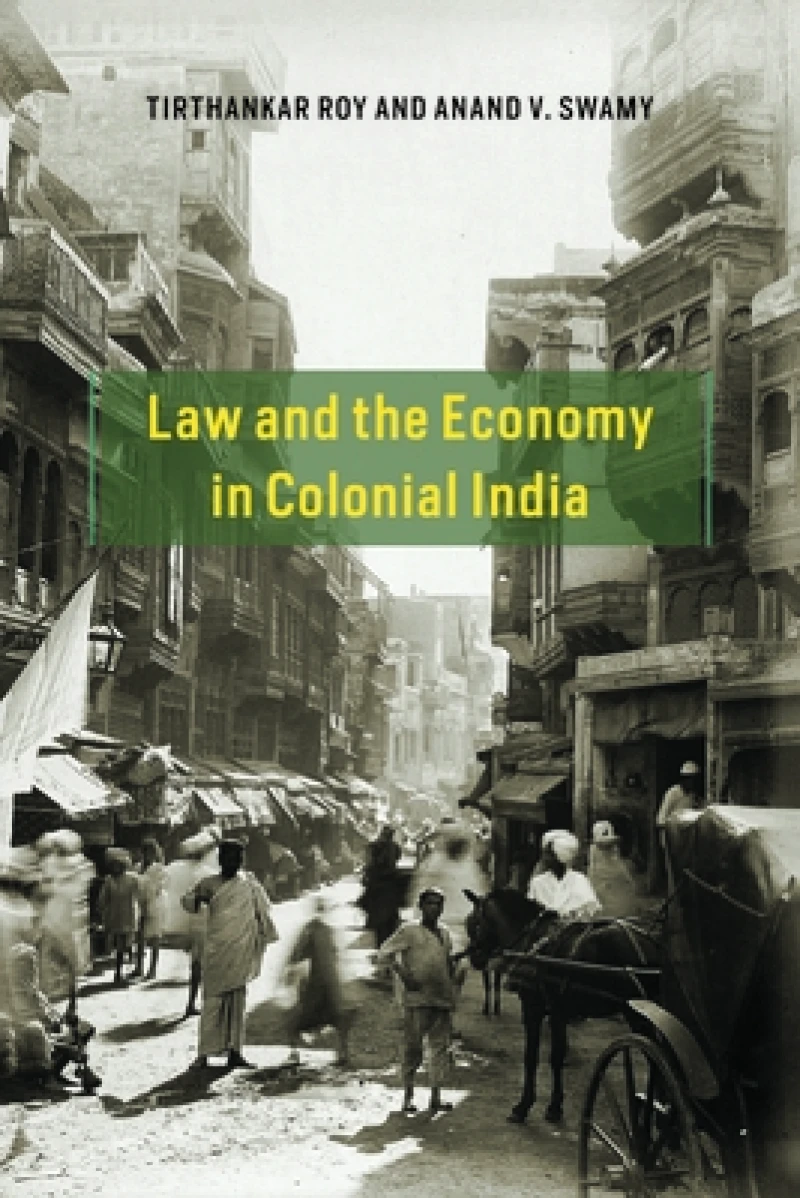
Law and the Economy in Colonial India
Book Details
Format
Hardback or Cased Book
Book Series
Markets and Governments in Economic History
ISBN-10
022638764X
ISBN-13
9780226387642
Publisher
The University of Chicago Press
Imprint
University of Chicago Press
Country of Manufacture
US
Country of Publication
GB
Publication Date
Sep 20th, 2016
Print length
256 Pages
Weight
488 grams
Dimensions
16.00 x 23.60 x 2.20 cms
Product Classification:
Development economics & emerging economiesLaws of Specific jurisdictions
Ksh 7,200.00
Werezi Extended Catalogue
0 in stock
Delivery Location
Delivery fee: Select location
Secure
Quality
Fast
Since the economic reforms of the 1990s, India's economy has grown rapidly. To sustain growth and foreign investment over the long run requires a well-developed legal infrastructure for conducting business, including cheap and reliable contract enforcement and secure property rights. But it's widely acknowledged that India's legal infrastructure is in urgent need of reform, plagued by problems, including slow enforcement of contracts and land laws that differ from state to state. How has this situation arisen, and what can boost business confidence and encourage long-run economic growth? Tirthankar Roy and Anand V. Swamy trace the beginnings of the current Indian legal system to the years of British colonial rule. They show how India inherited an elaborate legal system from the British colonial administration, which incorporated elements from both British Common Law and indigenous institutions. In the case of property law, especially as it applied to agricultural land, indigenous laws and local political expediency were more influential in law-making than concepts borrowed from European legal theory. Conversely, with commercial law, there was considerable borrowing from Europe. In all cases, the British struggled with limited capacity to enforce their laws and an insufficient knowledge of the enormous diversity and differentiation within Indian society. A disorderly body of laws, not conducive to production and trade, evolved over time. Roy and Swamy's careful analysis not only sheds new light on the development of legal institutions in India, but also offers insights for India and other emerging countries through a look at what fosters the types of institutions that are key to economic growth.
Get Law and the Economy in Colonial India by at the best price and quality guaranteed only at Werezi Africa's largest book ecommerce store. The book was published by The University of Chicago Press and it has pages.

