
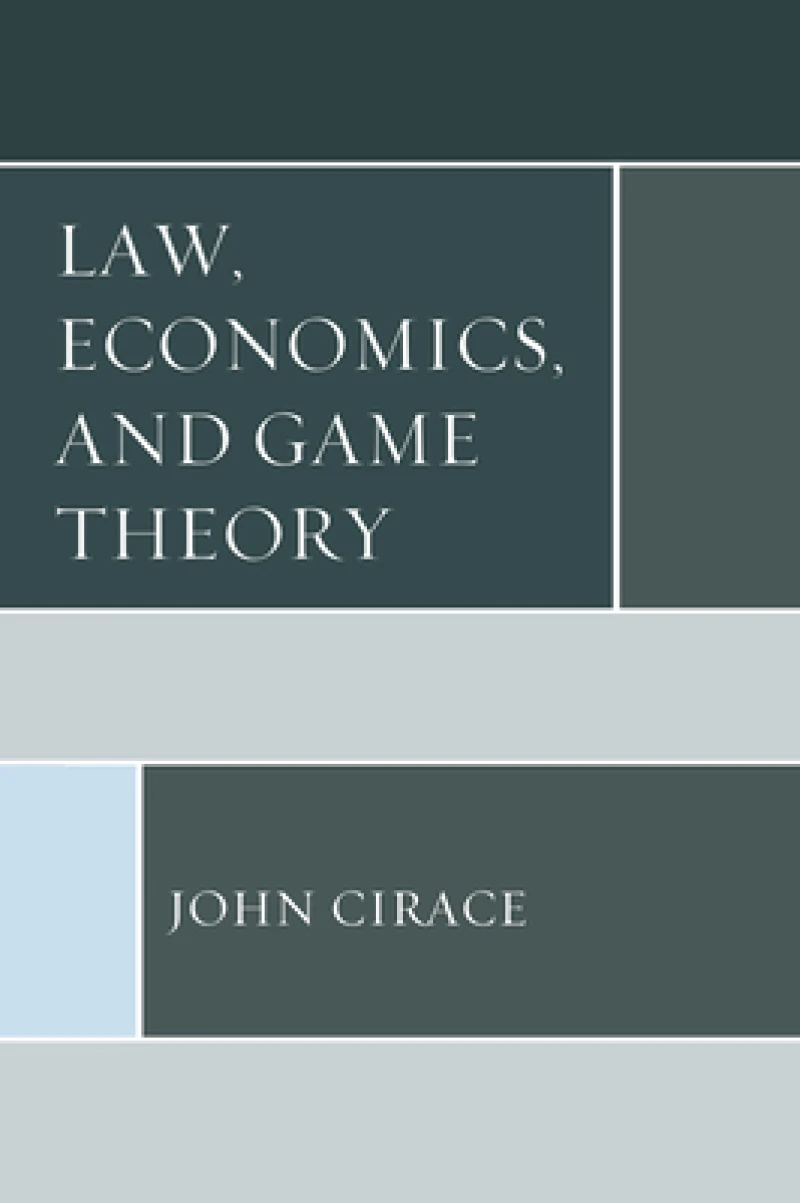
Law, Economics, and Game Theory
by
John Cirace
Book Details
Format
Paperback / Softback
ISBN-10
1498549101
ISBN-13
9781498549103
Publisher
Bloomsbury Publishing Plc
Imprint
Lexington Books
Country of Manufacture
GB
Country of Publication
GB
Publication Date
Jul 6th, 2020
Print length
474 Pages
Weight
730 grams
Dimensions
17.70 x 25.40 x 2.60 cms
Product Classification:
EconomicsJurisprudence & general issues
Ksh 8,900.00
Manufactured on Demand
0 in stock
Delivery Location
Delivery fee: Select location
Secure
Quality
Fast
This book uses game theory to explain conflict between individual self-interested behavior and cooperation in economic markets, lawsuits, and legislative bodies. It demonstrates the need for social regulation in addition to free markets and judicial decisions in common law cases.
This book considers three relationships: law and economics; economics and game theory; and game theory and law. Economists teach lawyers that economic principles cut across and integrate seemingly different legal subjects such as contracts, torts, and property. Correspondingly, lawyers teach economists that legal rationality is a separate and distinct decision-making process that can be formalized by behavioral rules that are parallel to and comparable with the behavioral rules of economic rationality, that efficiency often must be constrained by legal goals such as equal protection of the laws, due process, and horizontal and distributional equity, and that the general case methodology of economics vs. the hard case methodology of law for determining the truth or falsity of economic theories and theorems sometimes conflict.
Economics and Game Theory: Law and economics books focus on economic analysis of judges’ decisions in common law cases and have been mostly limited to contracts, torts, property, criminal law, and suit and settlement. There is usually no discussion of the many areas of law that require cooperative action such as is needed to provide economic infrastructure, control public “bad” type externalities, and make legislation. Game theory provides the bridge between competitive markets and the missing discussion of cooperative action in law and economics. How? Competitive markets are examples (subset) of the Prisoners’ Dilemma, which explains the conflict between individual self-interested behavior and cooperation both in economic markets and in legislative bodies and demonstrates the need for social infrastructure and regulation of pollution and global warming.
Game Theory and Law: Lawsuits usually involve litigation between two parties, not the myriad participants in markets, so the assumption of self-interest constrained by markets does not carry over to legal disputes involving one-on-one bargaining in which the law gives one party superior bargaining power. Game theory models predict the effect of different legal institutions, rights, and rules on the outcome of such bargaining. Game theory also has a natural four-model framework which is used in this book to analyze the law and economics of civil obligation, which consists of torts (negligence), contracts, and unjust enrichment.
Economics and Game Theory: Law and economics books focus on economic analysis of judges’ decisions in common law cases and have been mostly limited to contracts, torts, property, criminal law, and suit and settlement. There is usually no discussion of the many areas of law that require cooperative action such as is needed to provide economic infrastructure, control public “bad” type externalities, and make legislation. Game theory provides the bridge between competitive markets and the missing discussion of cooperative action in law and economics. How? Competitive markets are examples (subset) of the Prisoners’ Dilemma, which explains the conflict between individual self-interested behavior and cooperation both in economic markets and in legislative bodies and demonstrates the need for social infrastructure and regulation of pollution and global warming.
Game Theory and Law: Lawsuits usually involve litigation between two parties, not the myriad participants in markets, so the assumption of self-interest constrained by markets does not carry over to legal disputes involving one-on-one bargaining in which the law gives one party superior bargaining power. Game theory models predict the effect of different legal institutions, rights, and rules on the outcome of such bargaining. Game theory also has a natural four-model framework which is used in this book to analyze the law and economics of civil obligation, which consists of torts (negligence), contracts, and unjust enrichment.
Get Law, Economics, and Game Theory by at the best price and quality guaranteed only at Werezi Africa's largest book ecommerce store. The book was published by Bloomsbury Publishing Plc and it has pages.

