
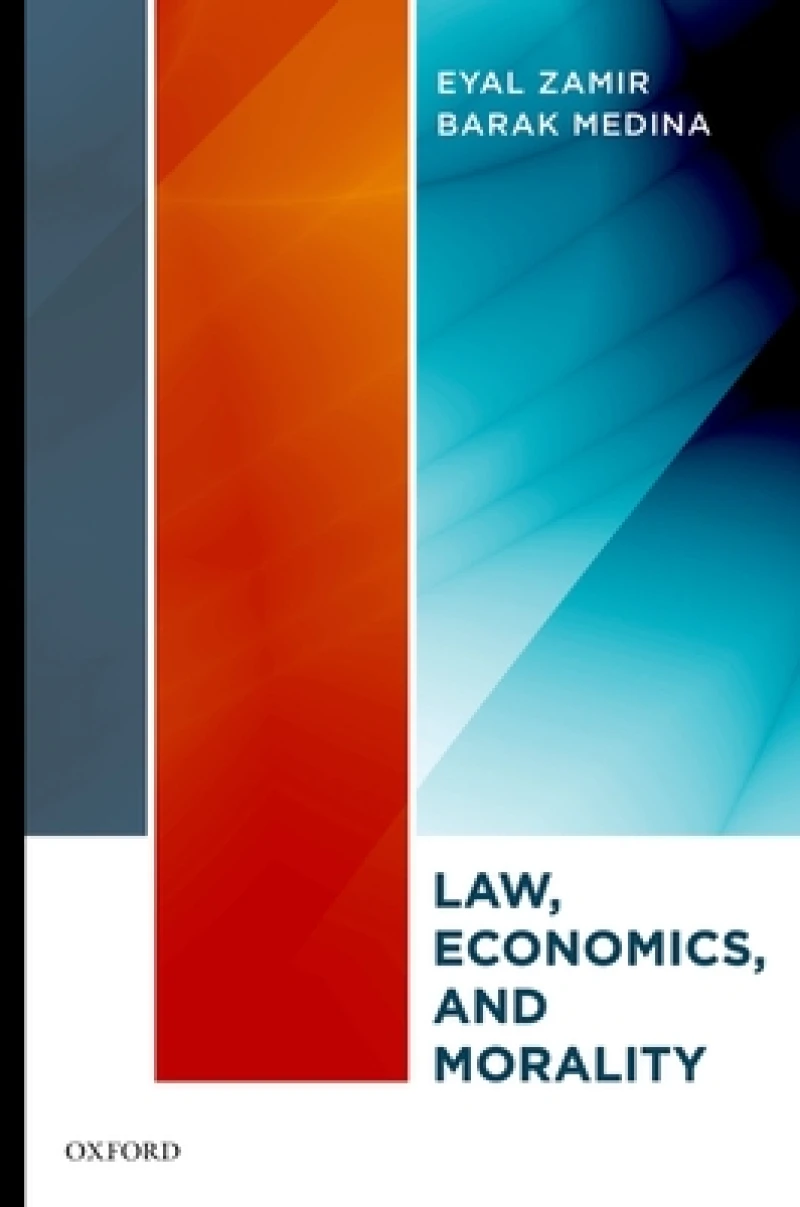
Law, Economics, and Morality
Book Details
Format
Hardback or Cased Book
ISBN-10
0195372166
ISBN-13
9780195372168
Publisher
Oxford University Press Inc
Imprint
Oxford University Press Inc
Country of Manufacture
GB
Country of Publication
GB
Publication Date
Apr 8th, 2010
Print length
376 Pages
Weight
703 grams
Dimensions
23.60 x 16.40 x 2.60 cms
Product Classification:
Ethics & moral philosophyEconomicsInternational human rights law
Ksh 22,800.00
Manufactured on Demand
0 in stock
Delivery Location
Delivery fee: Select location
Secure
Quality
Fast
Law, Economics, and Morality examines the possibility of combining economic methodology and deontological morality through explicit and direct incorporation of moral constraints into economic models. Economic analysis of law is a powerful analytical methodology. However, as a purely consequentialist approach, which determines the desirability of acts and rules solely by assessing the goodness of their outcomes, standard cost-benefit analysis (CBA) is normatively objectionable. Moderate deontology prioritizes such values as autonomy, basic liberties, truth-telling, and promise-keeping over the promotion of good outcomes. It holds that there are constraints on promoting the good. Such constraints may be overridden only if enough good (or bad) is at stake. While moderate deontology conforms to prevailing moral intuitions and legal doctrines, it is arguably lacking in methodological rigor and precision.Eyal Zamir and Barak Medina argue that the normative flaws of economic analysis can be rectified without relinquishing its methodological advantages and that moral constraints can be formalized so as to make their analysis more rigorous. They discuss various substantive and methodological choices involved in modeling deontological constraints. Zamir and Medina propose to determine the permissibility of any act or rule infringing a deontological constraint by means of mathematical threshold functions. Law, Economics, and Morality presents the general structure of threshold functions, analyzes their elements and addresses possible objections to this proposal. It then illustrates the implementation of constrained CBA in several legal fields, including contract law, freedom of speech, antidiscrimination law, the fight against terrorism, and legal paternalism.
Law, Economics, and Morality examines the possibility of combining economic methodology and deontological morality through explicit and direct incorporation of moral constraints into economic models. Economic analysis of law is a powerful analytical methodology. However, as a purely consequentialist approach, which determines the desirability of acts and rules solely by assessing the goodness of their outcomes, standard cost-benefit analysis (CBA) is normatively objectionable. Moderate deontology prioritizes such values as autonomy, basic liberties, truth-telling, and promise-keeping over the promotion of good outcomes. It holds that there are constraints on promoting the good. Such constraints may be overridden only if enough good (or bad) is at stake. While moderate deontology conforms to prevailing moral intuitions and legal doctrines, it is arguably lacking in methodological rigor and precision. Eyal Zamir and Barak Medina argue that the normative flaws of economic analysis can be rectified without relinquishing its methodological advantages and that moral constraints can be formalized so as to make their analysis more rigorous. They discuss various substantive and methodological choices involved in modeling deontological constraints. Zamir and Medina propose to determine the permissibility of any act or rule infringing a deontological constraint by means of mathematical threshold functions. Law, Economics, and Morality presents the general structure of threshold functions, analyzes their elements and addresses possible objections to this proposal. It then illustrates the implementation of constrained CBA in several legal fields, including contract law, freedom of speech, antidiscrimination law, the fight against terrorism, and legal paternalism.
Get Law, Economics, and Morality by at the best price and quality guaranteed only at Werezi Africa's largest book ecommerce store. The book was published by Oxford University Press Inc and it has pages.

