
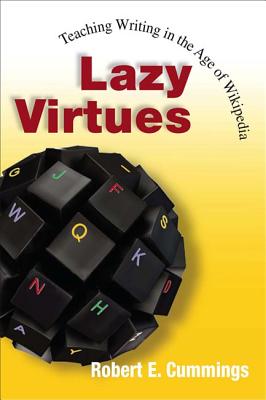
Lazy Virtues : Teaching Writing in the Age of Wikipedia
Book Details
Format
Hardback
ISBN-10
0826516157
ISBN-13
9780826516152
Publisher
Vanderbilt University Press
Imprint
Vanderbilt University Press
Country of Manufacture
US
Country of Publication
GB
Publication Date
Aug 20th, 2026
Print length
216 Pages
KSh 14,400.00
Not Yet Published
0 in stock
Delivery Location
Delivery fee: Select location
Secure
Quality
Fast
Focusing on the controversial website Wikipedia, the author explores the challenges confronting teachers of college writing in the electronic and networked writing environments their students use every day.
Focusing largely on the controversial website Wikipedia, the author explores the challenges confronting teachers of college writing in the increasingly electronic and networked writing environments their students use every day. Rather than praising or condemning that site for its role as an encyclopedia, Cummings instead sees it as a site for online collaboration between writers and a way to garner audience for student writing.Applying an understanding of Commons-Based Peer Production theory, as developed by Yochai Benkler, this text is arranged around five key propositions: Commons-Based Peer Production is a novel economic phenomenon which informs our current teaching model and describes a method for making sense of future electronic developments; college writers are motivated to do their best work when they write for an authentic audience, external to the class; writing for a networked knowledge community invites students to participate in making knowledge, rather than only consuming it; a plan for integrating networked writing for an external audience helps students understand the transition from high school to college writing; and, allowing students to review and self-select points of entry into electronic discourse fosters ""laziness,"" or a new work dynamic where writers seek to better understand their own creativity in terms of a project's demands. ""Lazy Virtues"" offers networked writing assignments to foster development of student writers by exposing them to the demands of professional audiences, asking them to identify and assess their own creative impulses in terms of a project's needs, and removing the writing teacher from the role of sole audience.
Get Lazy Virtues by Robert E. Cummings at the best price and quality guaranteed only at Werezi Africa's largest book ecommerce store. The book was published by Vanderbilt University Press and it has 216 pages.
Customers Who Bought This Also Bought

Learning Mandarin Chinese Characters
KSh 1,800.00

The Cleaving
KSh 3,600.00

Do the Work
KSh 1,450.00

For Everyone Bible Study Guide: John
KSh 1,250.00

The Broadview Guide to Writing: A Handbook for Students - Seventh Edition
KSh 10,800.00
The Muses Among Us
KSh 4,500.00
Oxford Discover: 3: Writing and Spelling
KSh 4,100.00

World is a Text: Writing About Visual and Popular Culture
KSh 11,100.00

All the Fun''s in How You Say a Thing
KSh 3,750.00
Broadview Guide to Writing: A Handbook for Students - Sixth Edition
KSh 9,550.00
User Guides, Manuals, and Technical Writing
KSh 4,850.00

Les Outils pour l''écrire
KSh 15,500.00
