
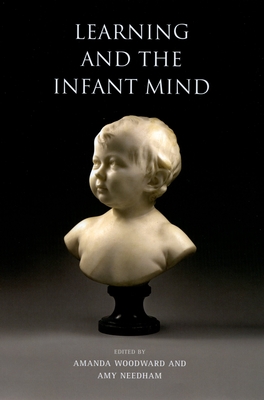
Learning and the Infant Mind
Book Details
Format
Hardback
ISBN-10
0195301153
ISBN-13
9780195301151
Publisher
Oxford University Press Inc
Imprint
Oxford University Press Inc
Country of Manufacture
GB
Country of Publication
GB
Publication Date
Oct 16th, 2008
Print length
352 Pages
Weight
654 grams
Dimensions
24.30 x 16.50 x 2.70 cms
Product Classification:
Child & developmental psychology
KSh 12,050.00
Temporarily out of stock, due soon
0 in stock
Delivery Location
Delivery fee: Select location
Secure
Quality
Fast
When asking how cognition comes to take its mature form, learning seems to be an obvious factor to consider. However, until quite recently, there has been very little contact between investigations of how infants learn and what infants know. For example, on the one hand, research efforts focused on infants' foundational conceptual knowledge-what they know about the physical permanence of objects, causal relations, and human intentions-often do not consider how learning may contribute to the structure of this knowledge. On the other hand, research efforts focused on infants' perceptual and motor learning-how they extract information from the environment, tune their behavior patterns according to this information, and generalize learning to new situations-often do not consider the potential impacts of these perceptual and learning mechanisms the structure of conceptual knowledge. Although each of these research efforts has made significant progress, this research has done little to narrow the divide between the disparate traditions of learning and knowledge. The chapters in this book document, for the first time, the insights that emerge when researchers who come from diverse domains and use different approaches make a genuine attempt to bridge this divide. The authors consider both infants' knowledge across domains, including knowledge of objects, physical relations between objects, categories, people, and language, and learning broadly construed, bringing to bear direct laboratory manipulations of learning and more general considerations of the relations between experience and knowledge. These authors have begun to consider whether and how the products of learning "go beyond" the input in several senses. As a result, several converging trends emerge across Whese diverse points of view. These authors have begun to investigate whether infants derive relatively abstract representations from experience, as well as the extent to which infants generalize information learned in one context to a new context. They have also begun to investigate the extent to which learning is generative, constraining and informing subsequent learning.
When asking how cognition comes to take its mature form, learning seems to be an obvious factor to consider. However, until quite recently, there has been very little contact between investigations of how infants learn and what infants know. For example, on the one hand, research efforts focused on infants'' foundational conceptual knowledge-what they know about the physical permanence of objects, causal relations, and human intentions-often do not consider how learning may contribute to the structure of this knowledge. On the other hand, research efforts focused on infants'' perceptual and motor learning-how they extract information from the environment, tune their behavior patterns according to this information, and generalize learning to new situations-often do not consider the potential impacts of these perceptual and learning mechanisms the structure of conceptual knowledge. Although each of these research efforts has made significant progress, this research has done little to narrow the divide between the disparate traditions of learning and knowledge. The chapters in this book document, for the first time, the insights that emerge when researchers who come from diverse domains and use different approaches make a genuine attempt to bridge this divide. The authors consider both infants'' knowledge across domains, including knowledge of objects, physical relations between objects, categories, people, and language, and learning broadly construed, bringing to bear direct laboratory manipulations of learning and more general considerations of the relations between experience and knowledge. These authors have begun to consider whether and how the products of learning "go beyond" the input in several senses. As a result, several converging trends emerge across Whese diverse points of view. These authors have begun to investigate whether infants derive relatively abstract representations from experience, as well as the extent to which infants generalize information learned in one context to a new context. They have also begun to investigate the extent to which learning is generative, constraining and informing subsequent learning.
Get Learning and the Infant Mind by Amanda Woodward at the best price and quality guaranteed only at Werezi Africa's largest book ecommerce store. The book was published by Oxford University Press Inc and it has 352 pages.
Customers Who Bought This Also Bought

The Anxious Generation
KSh 2,000.00

Restoring Childhood
KSh 3,050.00

Bible old testament bindup_8x8
KSh 2,450.00
The Einstein Syndrome
KSh 3,200.00

Restoring Childhood
KSh 4,500.00
Free to Learn
KSh 3,050.00

Key Issues in Childhood and Youth Studies
KSh 8,000.00
Key Issues in Childhood and Youth Studies
KSh 30,950.00

Outsmart Anxiety
KSh 4,700.00
How Children Succeed
KSh 3,400.00
Helping Children Succeed
KSh 3,050.00

The Life and Creative Works of Paulo Coelho
KSh 21,600.00
