
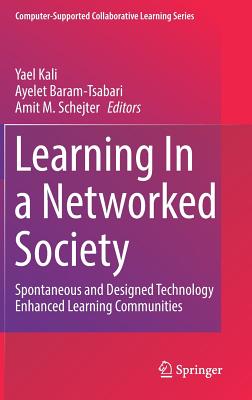
Learning In a Networked Society : Spontaneous and Designed Technology Enhanced Learning Communities
2019 ed.
Book Details
Format
Hardback
Book Series
Computer-Supported Collaborative Learning Series
ISBN-10
303014609X
ISBN-13
9783030146092
Edition
2019 ed.
Publisher
Springer Nature Switzerland AG
Imprint
Springer Nature Switzerland AG
Country of Manufacture
CH
Country of Publication
GB
Publication Date
May 8th, 2019
Print length
263 Pages
KSh 23,400.00
Currently unavailable
0 in stock
Delivery Location
Delivery fee: Select location
Secure
Quality
Fast
One of the most significant developments in contemporary education is the view that knowing and understanding are anchored in cultural practices within communities. This shift coincides with technological advancements that have reoriented end-user computer interaction from individual work to communication, participation and collaboration. However, while daily interactions are increasingly engulfed in mobile and networked Information and Communication Technologies (ICT), in-school learning interactions are, in comparison, technologically impoverished, creating the phenomenon known as the school-society digital disconnect. This volume argues that the theoretical and practical tools of scientists in both the social and educational sciences must be brought together in order to examine what types of interaction, knowledge construction, social organization and power structures: (a) occur spontaneously in technology-enhanced learning (TEL) communities or (b) can be created by design of TEL. This volume seeks to equip scholars and researchers within the fields of education, educational psychology, science communication, social welfare, information sciences, and instructional design, as well as practitioners and policy-makers, with empirical and theoretical insights, and evidence-based support for decisions providing learners and citizens with 21st century skills and knowledge, and supporting well-being in today''s information-based networked society.
Get Learning In a Networked Society by Amit M. Schejter at the best price and quality guaranteed only at Werezi Africa's largest book ecommerce store. The book was published by Springer Nature Switzerland AG and it has 263 pages.
Customers Who Bought This Also Bought

Make It Stick – The Science of Successful Learning
KSh 5,200.00

The Perks of Being a Bookworm
KSh 4,500.00

Helping Children Succeed
KSh 3,050.00

Secondary Traumatic Stress in Teaching
KSh 5,750.00

Learning Without Lessons
KSh 13,100.00

Teaching with the Brain in Mind
KSh 5,150.00

Teaching with the HEART in Mind
KSh 3,700.00

Teaching in the Wobble
KSh 5,750.00

Enhancing Teaching and Learning through Assessment
KSh 32,400.00

Authority and the Teacher
KSh 5,200.00

School Didactics And Learning
KSh 30,950.00

Text Messaging and Literacy - The Evidence
KSh 30,950.00
