
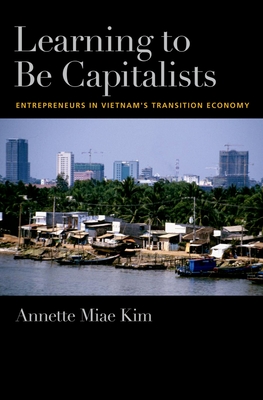
Learning to be Capitalists : Entrepreneurs in Vietnam's Transition Economy
Book Details
Format
Hardback
ISBN-10
0195369394
ISBN-13
9780195369397
Publisher
Oxford University Press Inc
Imprint
Oxford University Press Inc
Country of Manufacture
US
Country of Publication
GB
Publication Date
Sep 25th, 2008
Print length
224 Pages
Weight
510 grams
Dimensions
15.50 x 23.90 x 1.80 cms
Product Classification:
Development studiesEconomic growthEntrepreneurship
KSh 9,150.00
Temporarily out of stock, due soon
0 in stock
Delivery Location
Delivery fee: Select location
Secure
Quality
Fast
This book examines Ho Chi Minh City's first generation of entrepreneurs to find that a society-wide reconstruction of cognitive paradigms enabled them and others to transform Vietnam from a poor, centrally planned economy to one of the fastest growing, market economies in the world, despite ignoring conventional reform strategies.
Given the overwhelming number of ineffective economic reform policies and programs, a central question for international development concerns how significant economic change happens. In the midst of this quandary, a puzzle has been growing quietly the last two decades. Vietnam has transitioned from a poor, centrally planned economy to one of the fastest growing, market economies in the world, despite ignoring conventional reform strategies. This book focuses on solving a specific puzzle of Vietnam''s transition. Its fastest growing city, Ho Chi Minh City, has a real estate industry that ranks as the worst place in the world for private capital to invest . Nevertheless, entrepreneurs have emerged to form private firms within the first decade of transition. Where did these people come from? How could they conduct business in such an inhospitable economic environment? The book finds that the transition to capitalism is neither the natural propensity of individuals nor the decision of an all-powerful state nor necessarily requires a long, evolutionary process. The major, rapid, and discontinuous economic change that occurred in Vietnam was fundamentally enabled by a social reconstruction of cognitive paradigms. The new social cognition framework accounts for why some firms were more successful than others as well as why Vietnam''s capitalism has surprising characteristics.
Get Learning to be Capitalists by Annette Miae Kim at the best price and quality guaranteed only at Werezi Africa's largest book ecommerce store. The book was published by Oxford University Press Inc and it has 224 pages.
Customers Who Bought This Also Bought

How Africa Works
KSh 3,050.00

Development as Freedom
KSh 2,900.00

How Africa Works
KSh 4,500.00

Anti-Politics Machine
KSh 3,750.00

We Are Not Able to Live in the Sky
KSh 3,400.00
Apostles of Development
KSh 5,600.00

The Bottom Billion
KSh 2,500.00
Indigenous Knowledge Inquiries
KSh 6,600.00

Why Africa is poor
KSh 2,350.00

Historical Dictionary of Aid and Development Organizations
KSh 12,050.00

Contemporary Latin American Architecture
KSh 7,900.00
The Poverty of Growth
KSh 2,900.00
