
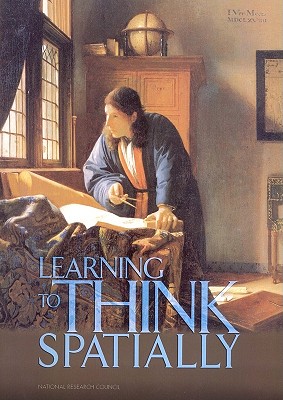
Learning to Think Spatially
Book Details
Format
Paperback / softback
ISBN-10
0309092086
ISBN-13
9780309092081
Publisher
National Academies Press
Imprint
National Academies Press
Country of Manufacture
US
Country of Publication
GB
Publication Date
Jan 3rd, 2005
Print length
332 Pages
Weight
301 grams
Dimensions
25.40 x 17.80 x 2.50 cms
Product Classification:
PsychologyEducational psychologyTeaching skills & techniquesTeaching skills and techniques
KSh 11,000.00
Publisher Out of Stock
0 in stock
Delivery Location
Delivery fee: Select location
Secure
Quality
Fast
Spatial thinking - a constructive combination of concepts of space, tools of representation, and processes of reasoning - uses space to structure problems, find answers, and express solutions. This book examines how spatial thinking might be incorporated into existing standards-based instruction across the school curriculum.
Learning to Think Spatially examines how spatial thinking might be incorporated into existing standards-based instruction across the school curriculum. Spatial thinking must be recognized as a fundamental part of K–12 education and as an integrator and a facilitator for problem solving across the curriculum. With advances in computing technologies and the increasing availability of geospatial data, spatial thinking will play a significant role in the information-based economy of the twenty-first century. Using appropriately designed support systems tailored to the K–12 context, spatial thinking can be taught formally to all students. A geographic information system (GIS) offers one example of a high-technology support system that can enable students and teachers to practice and apply spatial thinking in many areas of the curriculum.
Get Learning to Think Spatially by Board on Earth Sciences and Resources, Committee on Support for Thinking Spatially: The Incorporation of Geographic Information Science Ac at the best price and quality guaranteed only at Werezi Africa's largest book ecommerce store. The book was published by National Academies Press and it has 332 pages.
Customers Who Bought This Also Bought

This Too Shall Pass
KSh 2,000.00

Maybe You Should Talk to Someone
KSh 2,000.00
David and Goliath
KSh 2,350.00

Corruptible
KSh 2,350.00

Damaged but Not Destroyed
KSh 4,850.00

Antifragile
KSh 2,700.00
Late Bloomers
KSh 2,700.00
Mind Fixers – Psychiatry`s Troubled Search for the Biology of Mental Illness
KSh 2,900.00

The Life Of The Mind
KSh 3,950.00
Why You Act the Way You Do
KSh 1,600.00

Lost Girls
KSh 2,000.00

Dark Psychology and Manipulation
KSh 3,550.00
More by Board on Earth Sciences and Resources, Committee on Support for Thinking Spatially: The Incorporation of Geographic Information Science Ac
Living on an Active Earth
KSh 14,600.00

Calculating the Secrets of Life
KSh 24,650.00

Eager to Learn
KSh 9,550.00

Enhancing Professional Development for Teachers
KSh 7,400.00

Aviation Safety and Pilot Control
KSh 19,600.00
Vision and Voyages for Planetary Science in the Decade 2013-2022
KSh 7,550.00
Discipline-Based Education Research
KSh 6,650.00
Zero-Sustainment Aircraft for the U.S. Air Force
KSh 4,300.00

The Unique U.S.-Russian Relationship in Biological Science and Biotechnology
KSh 7,400.00

Technology Pathways
KSh 7,400.00

Implementing the New Biology
KSh 7,400.00
Sharing Research Data
KSh 29,350.00
