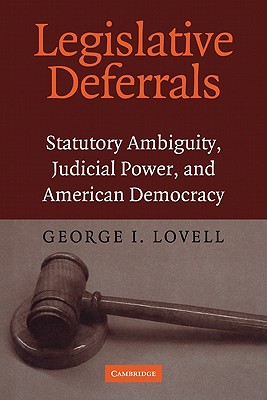

Legislative Deferrals : Statutory Ambiguity, Judicial Power, and American Democracy
Book Details
Format
Hardback
ISBN-10
052182415X
ISBN-13
9780521824156
Publisher
Cambridge University Press
Imprint
Cambridge University Press
Country of Manufacture
GB
Country of Publication
GB
Publication Date
Mar 31st, 2003
Print length
314 Pages
Weight
628 grams
Dimensions
16.20 x 23.60 x 2.60 cms
Product Classification:
North America (USA and Canada)Central / national / federal governmentCentral government
KSh 11,050.00
Currently unavailable
0 in stock
Delivery Location
Delivery fee: Select location
Secure
Quality
Fast
Judges in the United States are criticized for making law when they should be following the laws made by elected officials. This book argues that much of the blame for judicial policy-making lies with elected officials who sometimes deliberately allow judges to make policy decisions.
Why do unelected federal judges have so much power to make policy in the United States? Why were federal judges able to thwart apparent legislative victories won by labor organizations in the Lochner era? Most scholars who have addressed such questions assume that the answer lies in the judiciary's constitutionally guaranteed independence, and thus worry that insulated judges threaten democracy when they stray from baseline positions chosen by legislators. This book argues for a fundamental shift in the way scholars think about judicial policy-making. Scholars need to notice that legislators also empower judges to make policy as a means of escaping accountability. This study of legislative deference to the courts offers a dramatic reinterpretation of the history of twentieth-century labor law and shows how attention to legislative deferrals can help scholars to address vexing questions about the consequences of judicial power in a democracy.
Get Legislative Deferrals by George I. Lovell at the best price and quality guaranteed only at Werezi Africa's largest book ecommerce store. The book was published by Cambridge University Press and it has 314 pages.
Customers Who Bought This Also Bought

Confidence Man
KSh 2,350.00
Reagan – His Life and Legend
KSh 6,950.00

We the People
KSh 5,400.00
We the People
KSh 3,850.00

This America: The Case for the Nation
KSh 2,350.00

American Beast
KSh 2,700.00

Confidence Man
KSh 3,050.00
The Atomistic Congress
KSh 7,950.00

Occupational Hazards
KSh 2,350.00

Truss at 10
KSh 3,950.00

Truss at 10
KSh 2,350.00
Beyond Westminster in the Caribbean
KSh 4,150.00