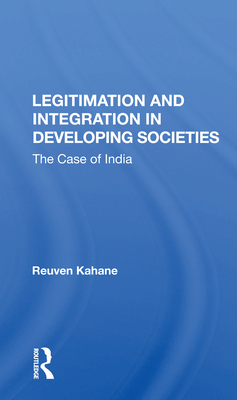
Legitimation And Integration In Developing Societies : The Case of India
Book Details
Format
Hardback
ISBN-10
0367020149
ISBN-13
9780367020149
Publisher
Taylor & Francis Ltd
Imprint
Routledge
Country of Manufacture
GB
Country of Publication
GB
Publication Date
Jun 7th, 2019
Print length
156 Pages
Weight
450 grams
Product Classification:
Sociology
KSh 30,950.00
Currently unavailable
0 in stock
Delivery Location
Delivery fee: Select location
Secure
Quality
Fast
Though characterized by great human diversity and subject to economic constraints–typically disintegrative forces–Indian society has managed to function in a democratic manner through institutionalization of conflict among the myriad of competing ethnic, religious, and political factions. The author of this book maintains that the relative unity of Indian society can be explained by its unique pattern of integration, which allows conflicting forces to cooperate through mediatory institutions. Such institutions, he argues, link differing codes of behavior and equalize opposing groups, creating structures that serve as bridging mechanisms within the society. Dr. Kahane goes beyond the example of India, pointing to general theoretical considerations important for the analysis of political legitimation and integration in diverse societies. He suggests a model of society in which conflicts are accentuated for integrative purposes, illustrates the structure of the mechanisms by which antagonistic elements of society are connected, and stresses that analysis of the patterns in which social units (political, cultural, and religious) are linked is often the most efficient means of explaining the nature of a given social order.
Get Legitimation And Integration In Developing Societies by Reuven Kahane at the best price and quality guaranteed only at Werezi Africa's largest book ecommerce store. The book was published by Taylor & Francis Ltd and it has 156 pages.
Customers Who Bought This Also Bought

Caste
KSh 2,700.00

On Freedom
KSh 2,350.00

Extinction of Experience
KSh 3,950.00

Revenge of the Tipping Point
KSh 2,350.00

Lost Girls
KSh 2,000.00

Right to Sex
KSh 2,000.00

Caste
KSh 4,550.00

Revenge of the Tipping Point
KSh 4,500.00

Revenge of the Tipping Point
KSh 3,050.00

Can Feminism Be African
KSh 2,000.00

Can Feminism Be African
KSh 3,950.00

History of Sexuality: 2
KSh 2,350.00