
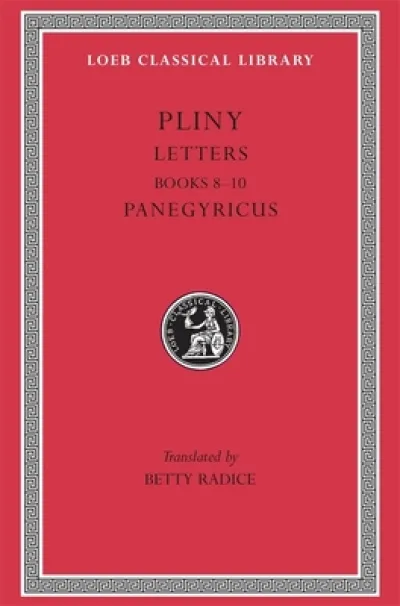
Letters, Volume II – Books 8–10. Panegyricus (Trans. Radice) (Latin) : Books 8–10. Panegyricus
Book Details
Format
Hardback or Cased Book
Book Series
Loeb Classical Library
ISBN-10
0674990668
ISBN-13
9780674990661
Publisher
Harvard University Press
Imprint
LOEB
Country of Manufacture
US
Country of Publication
GB
Publication Date
Jan 1st, 1969
Print length
592 Pages
Weight
410 grams
Dimensions
17.20 x 11.50 x 3.20 cms
Product Classification:
Literary essaysEssays
Ksh 4,500.00
Temporarily out of stock, due soon
0 in stock
Delivery Location
Delivery fee: Select location
Secure
Quality
Fast
The letters of Pliny the Younger (ca. AD 61–ca. 112), a polished social document of his times, include descriptions of the eruption of Vesuvius in AD 79 and the earliest pagan accounts of Christians. The Panegyricus is an expanded, published version of Pliny’s oration of thanks to the emperor Trajan in AD 100.
Correspondence from a distinguished and eventful life. The Younger Pliny was born in AD 61 or 62, the son of Lucius Caecilius of Comum (Como) and the Elder Pliny’s sister. He was educated at home and then in Rome under Quintilian. He was at Misenum at the time of the eruption of Vesuvius in 79 (described in two famous letters) when the Elder Pliny died. Pliny started his career at the Roman bar at the age of eighteen. He moved through the regular offices in a senator’s career, held two treasury appointments and a priesthood, and was consul in September and October 100. On this occasion he delivered the speech of thanks to the emperor Trajan that he afterwards expanded and published as the Panegyricus. After his consulship he returned to advocacy in the court and Senate, and was also president of the Tiber Conservancy Board. His hopes of retirement were cut short when he was chosen by Trajan to go out to the province of Bithynia and Pontus on a special commission as the emperor’s direct representative. He is known to have been there two years, and is presumed to have died there before the end of 113. Book 10 of the Letters contains his correspondence with Trajan during this period, and includes letters about the early Christians. Pliny’s Letters are important as a social document of his times. They tell us about the man himself and his wide interests, and about his many friends, including Tacitus, Martial, and Suetonius. Pliny has a gift for description and a versatile prose style, and more than any of his contemporaries he gives an unprejudiced picture of Rome as he knew it. The Loeb Classical Library edition of Pliny the Younger is in two volumes; the first contains Books 1–7 of his Letters and an Introduction.
Get Letters, Volume II – Books 8–10. Panegyricus (Trans. Radice) (Latin) by at the best price and quality guaranteed only at Werezi Africa's largest book ecommerce store. The book was published by Harvard University Press and it has pages.

