
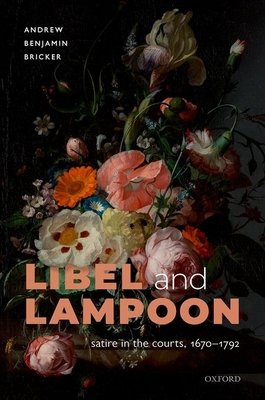
Libel and Lampoon : Satire in the Courts, 1670-1792
Book Details
Format
Hardback
Book Series
Law and Literature
ISBN-10
0192846159
ISBN-13
9780192846150
Publisher
Oxford University Press
Imprint
Oxford University Press
Country of Manufacture
GB
Country of Publication
GB
Publication Date
Feb 10th, 2022
Print length
342 Pages
Weight
684 grams
Dimensions
16.40 x 24.00 x 2.90 cms
Product Classification:
18th century, c 1700 to c 179919th century, c 1800 to c 1899Literary studies: generalLiterary studies: c 1500 to c 1800Literary studies: fiction, novelists & prose writersLiterary studies: fiction, novelists and prose writersModern history to 20th century: c 1700 to c 1900Legal historyHistory
KSh 18,650.00
Currently unavailable
0 in stock
Delivery Location
Delivery fee: Select location
Secure
Quality
Fast
Explores the mutually shaping influences of legal developments over the eighteenth century and the expression and form of satire in the period, from satirical literature to non-verbal forms including caricature.
Libel and Lampoon shows how English satire and the law mutually shaped each other during the long eighteenth century. Following the lapse of prepublication licensing in 1695, the authorities quickly turned to the courts and newly repurposed libel laws in an attempt to regulate the press. In response, satirists and their booksellers devised a range of evasions. Writers increasingly capitalized on forms of verbal ambiguity, including irony, allegory, circumlocution, and indirection, while shifty printers and booksellers turned to a host of publication ruses that complicated the mechanics of both detection and prosecution. In effect, the elegant insults, comical periphrases, and booksellers'' tricks that came to typify eighteenth-century satire were a way of writing and publishing born of legal necessity. Early on, these emergent satiric practices stymied the authorities and the courts. But they also led to new legislation and innovative courtroom procedures that targeted satire''s most routine evasions. Especially important were a series of rulings that increased the legal liabilities of printers and booksellers and that expanded and refined doctrines for the courtroom interpretation of verbal ambiguity, irony, and allegory. By the mid-eighteenth century, satirists and their booksellers faced a range of newfound legal pressures. Rather than disappearing, however, personal and political satire began to migrate to dramatic mimicry and caricature-acoustic and visual forms that relied less on verbal ambiguity and were therefore not subject to either the provisions of preperformance dramatic licensing or the courtroom interpretive procedures that had earlier enabled the prosecution of printed satire.
Get Libel and Lampoon by Andrew Benjamin Bricker at the best price and quality guaranteed only at Werezi Africa's largest book ecommerce store. The book was published by Oxford University Press and it has 342 pages.
Customers Who Bought This Also Bought
How to Read a Book
KSh 2,000.00
Decolonising the Mind
KSh 4,700.00

How to Read & Why
KSh 2,350.00
Arabian Nights'' Entertainments
KSh 2,950.00
In the Wake
KSh 3,600.00
The Birth of Tragedy
KSh 1,800.00
Against Nature
KSh 1,800.00
The White Album
KSh 3,250.00
Robinson Crusoe
KSh 1,450.00
Metaphysical Poetry
KSh 2,350.00
Reading Lessons
KSh 2,350.00

Literature Book
KSh 4,250.00
