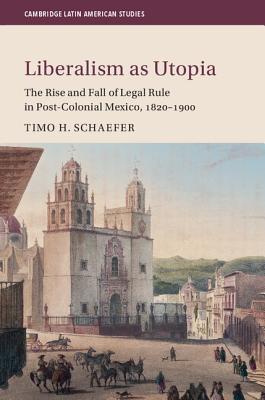
Liberalism as Utopia : The Rise and Fall of Legal Rule in Post-Colonial Mexico, 1820–1900
Book Details
Format
Paperback / softback
Book Series
Cambridge Latin American Studies
ISBN-10
1316640787
ISBN-13
9781316640784
Publisher
Cambridge University Press
Imprint
Cambridge University Press
Country of Manufacture
GB
Country of Publication
GB
Publication Date
Feb 28th, 2019
Print length
260 Pages
Weight
450 grams
Dimensions
23.00 x 15.30 x 1.50 cms
KSh 6,300.00
Currently unavailable
0 in stock
Delivery Location
Delivery fee: Select location
Secure
Quality
Fast
The book explores the creation of the post-colonial Mexican state by comparing the legal culture of mestizo towns, indigenous towns and agricultural estates (haciendas). More broadly, it is for readers interested in the social origins of liberalism and authoritarianism in the nineteenth-century world.
Liberalism as Utopia challenges widespread perceptions about the weakness of Mexico's nineteenth-century state. Schaefer argues that after the War of Independence non-elite Mexicans - peasants, day laborers, artisans, local merchants - pioneered an egalitarian form of legal rule by serving in the town governments and civic militias that became the local faces of the state's coercive authority. These institutions were effective because they embodied patriarchal norms of labor and care for the family that were premised on the legal equality of male, adult citizens. The book also examines the emergence of new, illiberal norms that challenged and at the end of the century, during the dictatorship of Porfirio Diaz, overwhelmed the egalitarianism of the early-republican period. By comparing the legal cultures of agricultural estates, mestizo towns and indigenous towns, Liberalism as Utopia also proposes a new way of understanding the social foundations of liberal and authoritarian pathways to state formation in the nineteenth-century world.
Get Liberalism as Utopia by Timo H. Schaefer at the best price and quality guaranteed only at Werezi Africa's largest book ecommerce store. The book was published by Cambridge University Press and it has 260 pages.
Customers Who Bought This Also Bought

Crusade for Justice – The Autobiography of Ida B. Wells, Second Edition
KSh 4,050.00

Killers of the Flower Moon
KSh 2,000.00

Warmth of Other Suns
KSh 3,050.00

Frederick Douglass
KSh 3,350.00

107 Days
KSh 4,500.00

Second Treatise of Government – Norton Library
KSh 1,600.00
Tuesdays With Morrie
KSh 2,000.00
My Bondage and My Freedom
KSh 1,600.00

Hidden Figures
KSh 2,000.00

America, América
KSh 3,650.00

Holding the Line
KSh 2,000.00

Nuclear Folly
KSh 3,050.00