
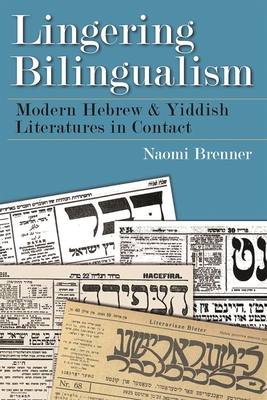
Lingering Bilingualism : Modern Hebrew and Yiddish Literatures in Contact
Book Details
Format
Hardback
Book Series
Judaic Traditions in Literature, Music, and Art
ISBN-10
0815634234
ISBN-13
9780815634232
Publisher
Syracuse University Press
Imprint
Syracuse University Press
Country of Manufacture
US
Country of Publication
GB
Publication Date
Jan 12th, 2016
Print length
320 Pages
Weight
585 grams
Dimensions
22.90 x 15.10 x 2.00 cms
KSh 8,650.00
Currently unavailable
0 in stock
Delivery Location
Delivery fee: Select location
Secure
Quality
Fast
At the beginning of the twentieth century, ambitious young writers flocked from Jewish towns and villages to cultural centers like Warsaw, Odessa, and Vilna to seek their fortunes. These writers, typically proficient in both Hebrew and Yiddish, gathered in literary salons and cafés to read, declaim, discuss, and ponder the present and future of Jewish culture. However, in the years before and after World War I, writers and readers increasingly immigrated to Western Europe, the Americas, and Palestine, transforming the multilingualism that had defined Jewish literary culture in Eastern Europe. By 1950, Hebrew was ensconced as the language and literature of the young state of Israel, and Yiddish was scattered throughout postwar Jewish communities in Europe and North and South America.
Lingering Bilingualism examines these early twentieth-century transformations of Jewish life and culture through the lens of modern Hebrew–Yiddish bilingualism. Exploring a series of encounters between Hebrew and Yiddish writers and texts, Brenner demonstrates how modern Hebrew and Yiddish literatures shifted from an established bilingualism to a dynamic translingualism in response to radical changes in Jewish ideology, geography, and culture. She analyzes how these literatures and their writers, translators, and critics intersected in places like Warsaw, Berlin, Tel Aviv, and New York—and imagined new paradigms for cultural production in Jewish languages. Her aim is neither to idealize the Hebrew–Yiddish bilingualism that once defined East European Jewish culture nor to recount the ""language war"" that challenged it. Rather, Lingering Bilingualism argues that continued Hebrew–Yiddish literary contact has been critical to the development of each literature, cultivating linguistic and literary experimentation and innovation.
Lingering Bilingualism examines these early twentieth-century transformations of Jewish life and culture through the lens of modern Hebrew–Yiddish bilingualism. Exploring a series of encounters between Hebrew and Yiddish writers and texts, Brenner demonstrates how modern Hebrew and Yiddish literatures shifted from an established bilingualism to a dynamic translingualism in response to radical changes in Jewish ideology, geography, and culture. She analyzes how these literatures and their writers, translators, and critics intersected in places like Warsaw, Berlin, Tel Aviv, and New York—and imagined new paradigms for cultural production in Jewish languages. Her aim is neither to idealize the Hebrew–Yiddish bilingualism that once defined East European Jewish culture nor to recount the ""language war"" that challenged it. Rather, Lingering Bilingualism argues that continued Hebrew–Yiddish literary contact has been critical to the development of each literature, cultivating linguistic and literary experimentation and innovation.
Get Lingering Bilingualism by Naomi Brenner at the best price and quality guaranteed only at Werezi Africa's largest book ecommerce store. The book was published by Syracuse University Press and it has 320 pages.
Customers Who Bought This Also Bought

Die Verwandlung/Metamorphosis
KSh 1,450.00

Digital Plurilingual Pedagogies in Teacher Education
KSh 27,900.00

Improving Academic Writing with AI
KSh 8,650.00

Improving Academic Writing with AI
KSh 30,950.00

Interlanguage Variation in Theoretical and Pedagogical Perspective
KSh 11,000.00
The Cambridge Handbook of Linguistic Multi-Competence
KSh 26,650.00

Countering Colonialingualism in Language Education
KSh 30,950.00
Language Exploration and Awareness
KSh 29,750.00
Deutsch im interkulturellen Begegnungsraum Ostmitteleuropa
KSh 20,350.00
Literacy, Storytelling and Bilingualism in Asian Classrooms
KSh 9,900.00
New Perspectives on Intercultural Language Research and Teaching
KSh 30,950.00
Language Contact in Nepal
KSh 10,800.00
More in This Genre
Die Verwandlung/Metamorphosis
KSh 1,450.00
Digital Plurilingual Pedagogies in Teacher Education
KSh 27,900.00
Improving Academic Writing with AI
KSh 8,650.00
Improving Academic Writing with AI
KSh 30,950.00
Interlanguage Variation in Theoretical and Pedagogical Perspective
KSh 11,000.00
The Cambridge Handbook of Linguistic Multi-Competence
KSh 26,650.00
