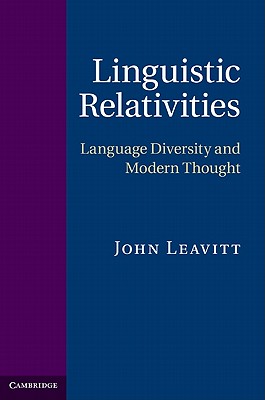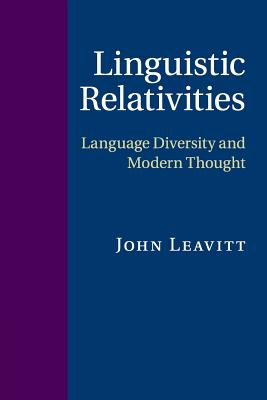
Linguistic Relativities : Language Diversity and Modern Thought
by
John Leavitt
Book Details
Format
Paperback / softback
ISBN-10
1107558638
ISBN-13
9781107558632
Publisher
Cambridge University Press
Imprint
Cambridge University Press
Country of Manufacture
GB
Country of Publication
GB
Publication Date
Oct 1st, 2015
Print length
256 Pages
Weight
35 grams
Dimensions
22.90 x 15.20 x 1.50 cms
KSh 7,550.00
Currently unavailable
0 in stock
Delivery Location
Delivery fee: Select location
Secure
Quality
Fast
Does the language you speak influence your thought and world view? This book offers a history of responses to this question over the last half millennium: usually a simple yes (Renaissance, Romantics, Neoromantics) or no (Enlightenment, most cognitive science), but sometimes more nuanced explorations (Boasian linguistics, recent work in cognition).
There are more than six thousand human languages, each one unique. For the last five hundred years, people have argued about how important language differences are. This book traces that history and shows how language differences have generally been treated either as of no importance or as all-important, depending on broader approaches taken to human life and knowledge. It was only in the twentieth century, in the work of Franz Boas and his students, that an attempt was made to engage seriously with the reality of language specificities. Since the 1950s, this work has been largely presented as yet another claim that language differences are all-important by cognitive scientists and philosophers who believe that such differences are of no importance. This book seeks to correct this misrepresentation and point to the new directions taken by the Boasians, directions now being recovered in the most recent work in psychology and linguistics.
Get Linguistic Relativities by John Leavitt at the best price and quality guaranteed only at Werezi Africa's largest book ecommerce store. The book was published by Cambridge University Press and it has 256 pages.
Customers Who Bought This Also Bought

Recognising the Stranger
KSh 1,800.00
The Origin of Language
KSh 4,500.00
Sharing Thoughts
KSh 17,000.00

An Inquiry Into Meaning and Truth
KSh 3,750.00
Semiotics and the Philosophy of Language
KSh 3,400.00
An Introduction to Logic
KSh 6,650.00

Walker Percy''s Search for Community
KSh 5,950.00
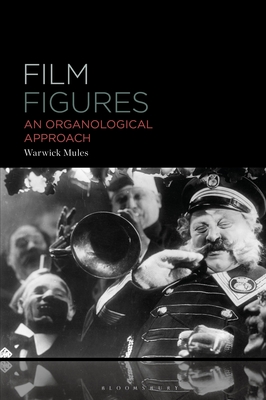
Film Figures
KSh 16,450.00

The Tacit Dimensions of Language and Logic
KSh 15,800.00

Metaphors in Action
KSh 21,600.00
Frontiers in Semiotics
KSh 3,000.00

A Theory of Death
KSh 11,900.00