

Linguistic Resources for Natural Language Processing : On the Necessity of Using Linguistic Methods to Develop NLP Software
Book Details
Format
Paperback / softback
ISBN-10
3031438132
ISBN-13
9783031438134
Publisher
Springer International Publishing AG
Imprint
Springer International Publishing AG
Country of Manufacture
GB
Country of Publication
GB
Publication Date
Mar 14th, 2025
Print length
217 Pages
Product Classification:
Computational and corpus linguisticsComputational linguisticsSocial research & statisticsSocial research and statisticsDigital and Information technology: general topicsInformation technology: general issuesArtificial intelligenceArtificial intelligence (AI)Natural language & machine translationNatural language and machine translation
KSh 23,400.00
Temporarily out of stock, due soon
0 in stock
Delivery Location
Delivery fee: Select location
Secure
Quality
Fast
Empirical — data-driven, neural network-based, probabilistic, and statistical — methods seem to be the modern trend. Recently, OpenAI’s ChatGPT, Google’s Bard and Microsoft’s Sydney chatbots have been garnering a lot of attention for their detailed answers across many knowledge domains. In consequence, most AI researchers are no longer interested in trying to understand what common intelligence is or how intelligent agents construct scenarios to solve various problems. Instead, they now develop systems that extract solutions from massive databases used as cheat sheets. In the same manner, Natural Language Processing (NLP) software that uses training corpora associated with empirical methods are trendy, as most researchers in NLP today use large training corpora, always to the detriment of the development of formalized dictionaries and grammars. Not questioning the intrinsic value of many software applications based on empirical methods, this volume aims at rehabilitating the linguistic approach to NLP. In an introduction, the editor uncovers several limitations and flaws of using training corpora to develop NLP applications, even the simplest ones, such as automatic taggers. The first part of the volume is dedicated to showing how carefully handcrafted linguistic resources could be successfully used to enhance current NLP software applications. The second part presents two representative cases where data-driven approaches cannot be implemented simply because there is not enough data available for low-resource languages. The third part addresses the problem of how to treat multiword units in NLP software, which is arguably the weakest point of NLP applications today but has a simple and elegant linguistic solution. It is the editor's belief that readers interested in Natural Language Processing will appreciate the importance of this volume, both for its questioning of the training corpus-based approaches and for the intrinsic value of the linguistic formalization and the underlying methodology presented.
Get Linguistic Resources for Natural Language Processing by Max Silberztein at the best price and quality guaranteed only at Werezi Africa's largest book ecommerce store. The book was published by Springer International Publishing AG and it has 217 pages.
Customers Who Bought This Also Bought

Patterns in Language and Communication
KSh 18,800.00

Second Language Acquisition
KSh 7,550.00

Construction Grammar and Sociolinguistic Theory
KSh 20,450.00
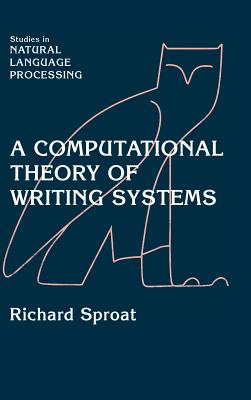
A Computational Theory of Writing Systems
KSh 18,900.00
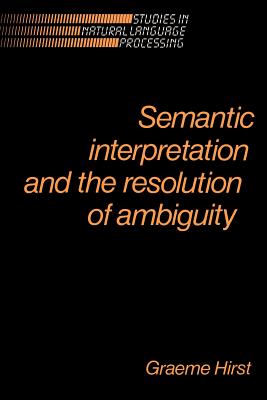
Semantic Interpretation and the Resolution of Ambiguity
KSh 7,600.00

Phraseology and Style in Subgenres of the Novel
KSh 21,600.00

A Course in Natural Language Processing
KSh 12,600.00

Deep Learning for Natural Language Processing
KSh 17,100.00

Corpora and Translation Education
KSh 23,400.00

Positionalities of Translation Studies
KSh 5,400.00

Humanities Data in R
KSh 16,200.00
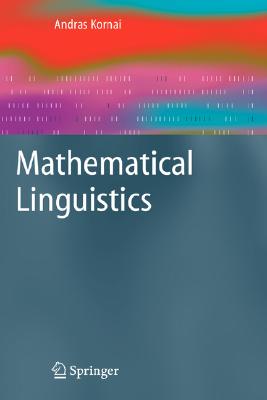
Mathematical Linguistics
KSh 12,600.00
More in This Genre
Patterns in Language and Communication
KSh 18,800.00
Second Language Acquisition
KSh 7,550.00
Construction Grammar and Sociolinguistic Theory
KSh 20,450.00
A Computational Theory of Writing Systems
KSh 18,900.00
Semantic Interpretation and the Resolution of Ambiguity
KSh 7,600.00
Phraseology and Style in Subgenres of the Novel
KSh 21,600.00
